Adaptive Agentic Orchestration: The Future of AI in Software Development
Explore the next frontier in software development: Adaptive Agentic Orchestration. This paradigm shifts from single AI assistants to collaborative ecosystems of specialized AI agents, dynamically coordinated to manage the entire SDLC. Discover how this approach tackles complex, real-world software projects.
The landscape of software development is undergoing a profound transformation, driven by the relentless advancements in artificial intelligence. For years, the dream of automated code generation has captivated developers and researchers alike. Initially, this vision often centered around a single, powerful AI assistant capable of conjuring code from high-level prompts. While impressive for specific tasks, this "one-agent-writes-code" paradigm quickly reveals its limitations when confronted with the intricate, evolving, and multi-faceted nature of real-world software projects.
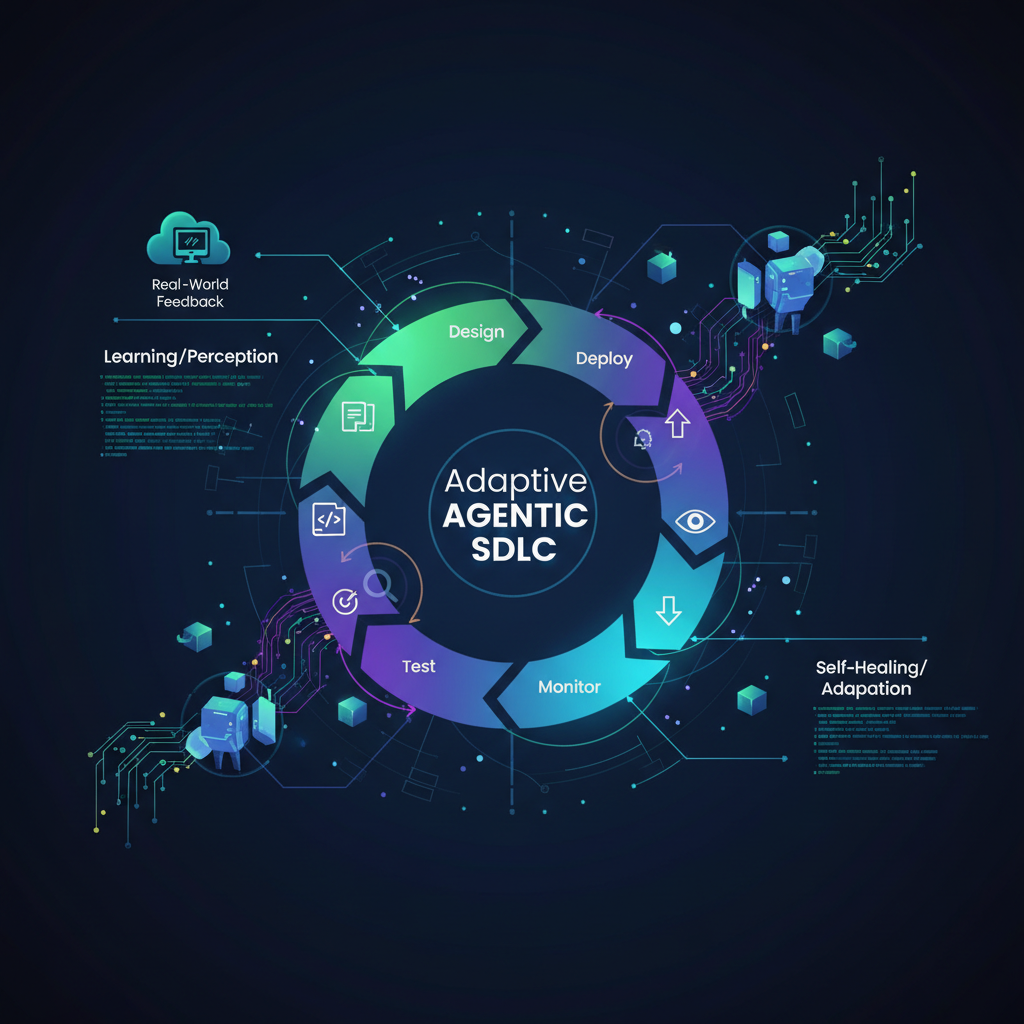
Enter Adaptive Agentic Orchestration for Complex Software Systems. This emerging field represents a significant leap forward, envisioning not a solitary AI genius, but a collaborative ecosystem of specialized AI agents, dynamically coordinated and managed to tackle the full spectrum of the Software Development Life Cycle (SDLC). It's a paradigm shift from simple automation to intelligent, distributed problem-solving, promising to redefine how we conceive, build, and maintain software.
The Imperative for Multi-Agent Systems in SDLC
Traditional SDLC methodologies, while robust, often grapple with inherent challenges: managing escalating complexity, adapting to constantly evolving requirements, mitigating technical debt, and ensuring seamless integration across diverse components. These issues are exacerbated in enterprise-scale applications, which demand more than just code snippets – they require architectural foresight, robust database design, intricate API development, rigorous testing, secure deployment, and continuous maintenance.
Single-agent solutions, often powered by Large Language Models (LLMs), excel at generating specific code blocks, drafting documentation, or even suggesting refactors. However, they typically lack the broader contextual understanding, persistent memory, and specialized expertise required to navigate the entire development lifecycle autonomously. Imagine asking a single architect to design a skyscraper, pour the concrete, wire the electricity, install the plumbing, and then inspect it for safety – it's an overwhelming and inefficient proposition.
This is where the power of Multi-Agent Systems (MAS) comes into play. The broader AI community has long recognized the efficacy of MAS in tackling complex problems across diverse domains, from robotics and scientific discovery to gaming and logistics. Applying this distributed intelligence model to SDLC is not merely an extension but a natural and powerful evolution. By breaking down the monolithic task of "software development" into a series of specialized, interdependent roles, we can leverage the strengths of individual agents while orchestrating their collaboration towards a unified goal. This approach promises to reduce development cycles, elevate code quality, and empower smaller teams to build increasingly sophisticated software, pushing the boundaries beyond mere "Hello World" applications.
Deconstructing the Adaptive Agentic Orchestration Framework
At its core, adaptive agentic orchestration is about intelligent task decomposition, dynamic assignment, and sophisticated inter-agent communication. It's a living system that can respond to changes, learn from feedback, and continuously optimize its own processes. Let's delve into the key concepts that underpin this powerful framework.
Specialized Agent Roles: The Intelligent Workforce
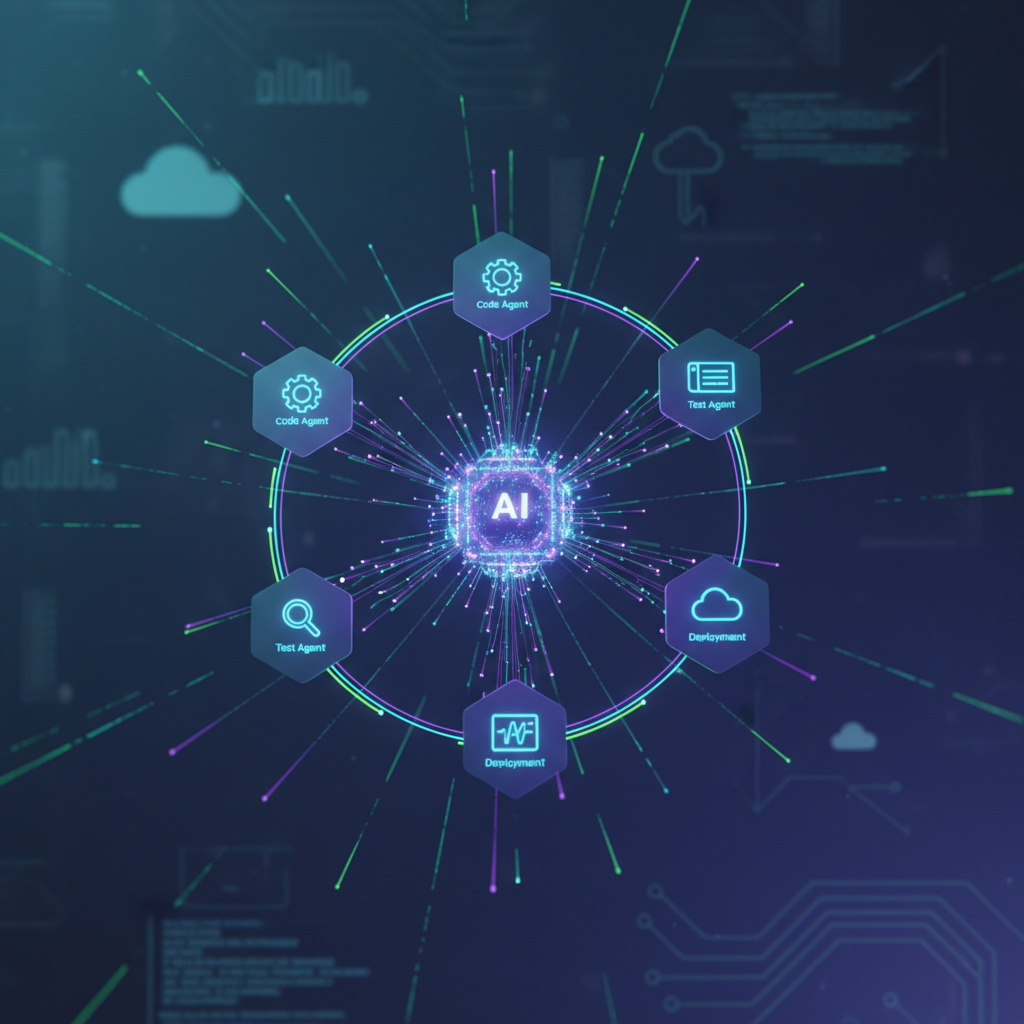
The foundation of any effective multi-agent system is the clear definition of specialized roles. Each agent is designed with a specific expertise, mirroring the diverse roles within a human development team. This modularity allows for deep specialization and efficient resource allocation.
- Architect Agent: This high-level agent is responsible for the strategic vision. It takes initial requirements and translates them into a coherent system architecture, defining modules, interfaces, data models, and setting technical standards. It acts as the blueprint creator, ensuring scalability, security, and maintainability.
- Feature Agent: Bridging the gap between high-level requirements and implementation, the Feature Agent breaks down user stories or epics into smaller, actionable tasks. It understands dependencies and sequences, preparing the ground for coding agents.
- Code Generation Agent: The workhorse of the system, this agent writes specific code components based on detailed specifications provided by the Feature Agent or Architect. It leverages advanced LLMs to generate high-quality, idiomatic code in various languages and frameworks.
- Test Agent: Crucial for quality assurance, the Test Agent generates comprehensive test cases (unit, integration, end-to-end), executes them, and meticulously reports bugs. It might employ techniques like property-based testing or fuzzing to uncover edge cases.
- Refactor Agent: Focused on code health, this agent continuously analyzes the codebase for technical debt, performance bottlenecks, and maintainability issues. It proposes and, with approval, implements refactoring strategies to improve code quality without altering external behavior.
- Integration Agent: In complex systems, ensuring seamless interaction between different modules and services is paramount. The Integration Agent manages dependencies, verifies API contracts, and resolves conflicts arising from inter-module communication.
- Deployment Agent: Automating the path to production, the Deployment Agent handles CI/CD pipelines, infrastructure provisioning (e.g., using Infrastructure as Code tools like Terraform or Ansible), and ensures secure and reliable deployments.
- Requirement/Product Agent: This agent acts as the interface with human stakeholders. It clarifies ambiguous requirements, provides progress updates, gathers feedback, and ensures the development process remains aligned with business goals.
Dynamic Task Decomposition and Assignment: The Intelligent Orchestrator
The true "intelligence" of the system lies in its ability to dynamically manage tasks. This moves beyond static assignments to an adaptive model where the system responds to real-time conditions.
- Hierarchical Planning: A "meta-agent" or central orchestrator (which could itself be an LLM-powered agent) receives a high-level goal (e.g., "Implement user authentication with OAuth2"). It then recursively breaks this down into smaller, manageable sub-tasks: "Design user schema," "Implement OAuth2 flow," "Create login UI," "Write unit tests for authentication," etc.
- Capability Matching: For each sub-task, the orchestrator identifies the most suitable specialized agent(s) based on their declared "skills" or capabilities. For instance, a "Design user schema" task would go to the Architect Agent or a dedicated Database Agent, while "Create login UI" would be assigned to a Frontend Agent. This ensures tasks are handled by the most competent entity.
- Adaptive Re-planning: This is where the "adaptive" nature shines. If a Code Generation Agent encounters a compilation error, or a Test Agent reports a critical bug, the orchestrator doesn't just halt. It dynamically re-evaluates the plan, re-assigns the problematic task (perhaps to the Refactor Agent for debugging, or back to the Code Generation Agent with more specific instructions), or even spawns a new specialized "Debugging Agent" if the issue is complex. Requirements changes from the Product Agent can also trigger a full or partial re-plan, ensuring agility.
Inter-Agent Communication and Collaboration Protocols: The Language of Cooperation
Effective collaboration hinges on clear and structured communication. Agents need more than just natural language; they need defined protocols to exchange information, tasks, and feedback efficiently.
- Shared Context/Memory: A common knowledge base or persistent memory store is vital. This could be a vector database, a graph database, or a simple key-value store where agents can store and retrieve project state, architectural decisions, code artifacts, test results, and even past conversations. This ensures all agents operate with a consistent and up-to-date understanding of the project.
- Structured Communication: While natural language is useful for high-level prompts and explanations, agents communicate primarily through structured data formats like JSON, YAML, or XML. This ensures unambiguous exchange of tasks, parameters, results, and feedback. For example, a Test Agent might send a JSON object detailing a failed test case, including the file path, line number, expected output, and actual output.
- Feedback Loops: Continuous feedback is the engine of iterative refinement. A Test Agent reporting a bug directly to the Code Generation Agent, which then attempts a fix, exemplifies a tight feedback loop. Similarly, the Architect Agent might review generated code for adherence to design principles and provide feedback to the Code Generation Agent.
- Conflict Resolution: In a multi-agent system, conflicts are inevitable. An Architect Agent might propose a database schema that conflicts with a performance optimization suggested by a Refactor Agent. Mechanisms for resolution could include:
- Negotiation: Agents exchange arguments and attempt to find a compromise.
- Voting: If multiple agents have opinions, a vote might be taken.
- Escalation to Human: For critical or unresolvable conflicts, the system flags the issue for human intervention, providing all relevant context.
Human-in-the-Loop (HITL) Integration: The Guiding Hand
Despite the ambition for autonomy, human oversight remains critical, especially in complex, high-stakes software development. HITL integration ensures that AI agents augment, rather than completely replace, human expertise.
- Supervisory Control: Humans define the high-level goals, set the strategic direction, and review critical architectural decisions. They act as the ultimate authority, providing approvals for major changes or deployments.
- Intervention Points: The system is designed to identify situations where human input is crucial. This could be ambiguous requirements that agents can't clarify, major architectural shifts with significant implications, or unresolvable conflicts between agents.
- Learning from Human Feedback: Every human correction, approval, or rejection becomes a valuable data point. Agents learn from these interactions, refining their decision-making processes, improving their understanding of human preferences, and enhancing their future performance. This continuous learning loop is vital for the system's long-term effectiveness.
Self-Correction and Self-Improvement: The Path to Autonomy
A truly adaptive system must be capable of learning and improving on its own. This involves mechanisms for error detection, performance monitoring, and knowledge base augmentation.
- Error Detection & Recovery: Agents are equipped to detect various types of errors – compilation errors, failed tests, runtime exceptions, or even logical inconsistencies. Upon detection, they attempt autonomous recovery (e.g., re-running a task with different parameters, consulting the Refactor Agent for a fix) or escalate the issue with detailed diagnostics.
- Performance Monitoring: The orchestrator continuously monitors the performance of individual agents and the overall system. This includes metrics like task completion rates, error rates, resource utilization, and adherence to deadlines. Bottlenecks or underperforming agents can be identified and addressed, potentially by re-assigning tasks or even "retraining" an agent with more relevant data.
- Knowledge Base Augmentation: Agents continuously enrich their internal knowledge bases. This includes learning new coding patterns, discovering best practices from successful implementations, and absorbing project-specific information. For instance, after successfully fixing a common type of bug, the Refactor Agent might add a new pattern to its internal library for future use.
Practical Applications and Transformative Use Cases
The theoretical underpinnings of adaptive agentic orchestration translate into tangible, transformative applications across the software development lifecycle.
- Automated Feature Development: Imagine providing a high-level user story like "As a user, I want to log in securely with my Google account." The agent system can then autonomously:
- Architect Agent designs the OAuth2 flow and database schema for user profiles.
- Feature Agent breaks this into tasks: "Implement Google OAuth callback," "Create user table," "Develop login UI component."
- Code Generation Agents write the backend API, database migrations, and frontend UI.
- Test Agent generates and runs unit, integration, and end-to-end tests.
- Integration Agent ensures the frontend and backend communicate correctly.
- Deployment Agent deploys the new feature to a staging environment. All with minimal human intervention, only requiring approval at critical junctures.
- Legacy System Modernization: Agents can analyze vast legacy codebases, identify outdated patterns, security vulnerabilities, and technical debt. A Refactor Agent might propose migration strategies (e.g., from a monolithic architecture to microservices), while Code Generation Agents implement the new components, and Test Agents ensure functional equivalence.
- Prototyping and MVP Generation: For startups or new projects, rapidly generating functional prototypes or Minimum Viable Products (MVPs) is crucial. An agentic system can take initial specifications and quickly scaffold a working application, allowing for early validation and iteration.
- Automated Bug Fixing: Given a bug report from a user or a monitoring system, along with relevant logs and stack traces, the agents can:
- Test Agent attempts to reproduce the bug.
- Refactor Agent analyzes the code, identifies the root cause, and proposes a fix.
- Code Generation Agent implements the fix.
- Test Agent verifies the fix and ensures no regressions. This significantly reduces the time from bug detection to resolution.
- Continuous Integration/Continuous Deployment (CI/CD) Enhancement: Agents can dynamically adapt CI/CD pipelines based on the nature of code changes. For instance, a minor documentation change might trigger a lightweight build and deploy, while a major architectural change could initiate a full suite of integration tests, security scans, and a phased rollout.
- Personalized Development Environments: Agents can tailor development tools, configurations, and even suggest relevant documentation or code examples based on a developer's preferences, current task, and project context, creating a hyper-efficient and personalized workspace.
Navigating the Future: Challenges and Opportunities
While the promise of adaptive agentic orchestration is immense, the path forward is not without its challenges. Addressing these will be critical for the widespread adoption and success of this paradigm.
- Scalability and Performance: Orchestrating hundreds or even thousands of agents for extremely large and complex projects presents significant computational and logistical hurdles. Efficient resource management, distributed computing, and optimized communication protocols will be paramount.
- Trust and Explainability: For critical systems, developers and stakeholders need to trust the agents' decisions. Ensuring transparency, providing clear explanations for architectural choices, code generation, and bug fixes will be essential for building confidence.
- Security and Compliance: Agents must be rigorously designed to prevent the introduction of security vulnerabilities or the violation of regulatory requirements (e.g., GDPR, HIPAA). This requires robust security protocols within the agent ecosystem and continuous auditing.
- Ethical Considerations: The implications for human developer roles are profound. How do we ensure a smooth transition? How do we mitigate potential biases in agent-generated code? These ethical questions require careful consideration and proactive solutions.
- Formal Verification: Proving the correctness and safety of agent-generated code and architectural decisions, especially in safety-critical domains, is a significant research frontier. Techniques from formal methods will likely play a crucial role.
- Learning and Adaptation: Developing agents that can continuously learn from project outcomes, human feedback, and evolving best practices without constant re-training is a complex challenge. This involves advanced machine learning techniques, including reinforcement learning and meta-learning.
- Standardization: As this field matures, the need for common protocols, APIs, and frameworks for multi-agent SDLC systems will become apparent. This will foster interoperability and accelerate innovation.
Conclusion: The Dawn of Collaborative AI Development
Adaptive Agentic Orchestration for Complex Software Systems represents a pivotal moment in the evolution of software development. It moves beyond the simplistic notion of AI as a mere code-generating tool, envisioning it as a collaborative ecosystem of intelligent, specialized agents working in concert. This paradigm shift promises to address many of the enduring challenges of traditional SDLC, offering unprecedented levels of automation, efficiency, and quality.
For AI practitioners and enthusiasts, this field is a vibrant research frontier brimming with opportunities. From designing novel agent architectures and communication protocols to developing sophisticated orchestration mechanisms and robust human-in-the-loop interfaces, the potential for innovation is boundless. By embracing this vision, we are not just building better tools; we are fundamentally reshaping the future of software creation, where AI agents become not just assistants, but integral, intelligent partners in crafting the next generation of software marvels. The era of truly collaborative AI development is not just on the horizon; it is already beginning to unfold.