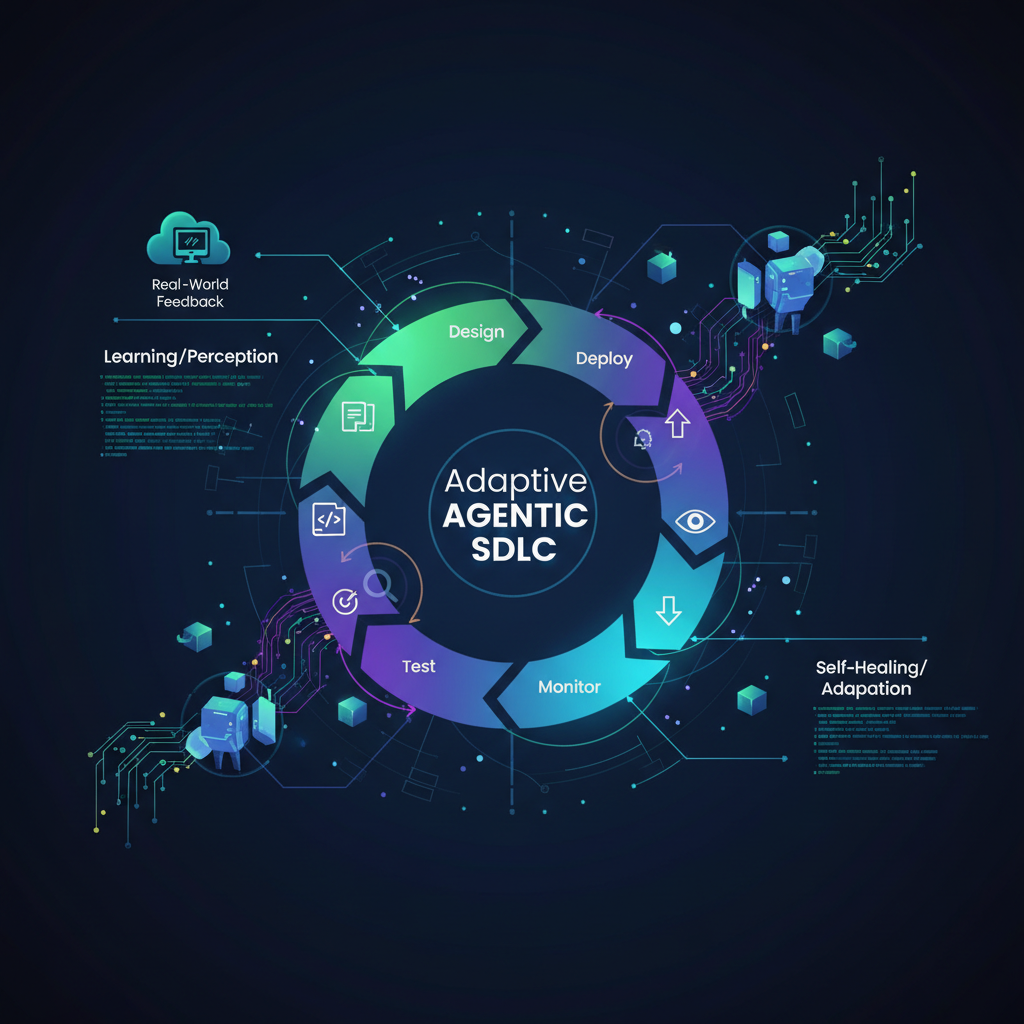
Adaptive Agentic SDLC: Navigating Dynamic Requirements and Evolving Environments
Explore the next frontier of Software Development Life Cycles (SDLC) with adaptive AI agents. Discover how intelligent systems can perceive, reason, plan, and adapt throughout the entire software lifecycle, moving beyond simple code generation to become proactive partners in navigating turbulent development landscapes.
The software development landscape is a turbulent sea, not a placid lake. Requirements shift like sand dunes, technologies emerge and deprecate with dizzying speed, and the very environments our applications inhabit are in constant flux. Traditional Software Development Life Cycles (SDLCs), often built on the premise of fixed specifications and predictable environments, frequently buckle under this relentless dynamism. Enter the next frontier of Agentic SDLC: Adaptive Agentic SDLC for Dynamic Requirements and Evolving Environments.
This isn't just about AI agents writing code from a prompt anymore. This is about intelligent systems that can perceive, reason, plan, act, and crucially, adapt throughout the entire software lifecycle. It's a vision where AI agents become proactive partners, not just code generators, navigating the inherent messiness of real-world software development.
The Imperative for Adaptation: Why Dynamic SDLC Matters
The move towards adaptive agentic systems isn't a luxury; it's a necessity driven by several undeniable realities of modern software engineering:
-
The Myth of Static Requirements: In today's agile world, business needs are fluid. User feedback, market shifts, and competitive pressures constantly reshape product visions. An SDLC that cannot gracefully accommodate these changes leads to costly rework, missed deadlines, and ultimately, products that fail to meet evolving user needs.
-
Beyond Code Generation: The Full Lifecycle: Initial forays into agentic SDLC rightly focused on automating code generation. However, the true value emerges when agents can understand the broader context, monitor execution, identify discrepancies, propose solutions, and iterate across the entire development cycle—from ideation to deployment and maintenance.
-
The Pace of Technological Evolution: New APIs, breaking changes in libraries, framework updates, and cloud service shifts are daily occurrences. Manually tracking and adapting to these external environmental factors is a significant drain on developer resources and a common source of technical debt.
-
Addressing Core SDLC Pain Points: Adaptive agents offer a direct assault on long-standing challenges:
- Technical Debt: Proactive refactoring and dependency management.
- Maintenance Burden: Autonomous adaptation to new environments.
- Slow Iteration Cycles: Faster response to changes and continuous improvement.
- Scope Creep: Intelligent management of evolving requirements.
-
Emerging Agent Architectures: Recent advancements in multi-agent systems, long-context models, planning agents, and reflective agents are no longer theoretical. They are providing the architectural building blocks to make this adaptive capability increasingly feasible.
Core Concepts: Building Blocks of Adaptive Agentic SDLC
To achieve true adaptiveness, agentic systems must integrate several sophisticated capabilities, moving beyond simple prompt-to-code translation.
1. Continuous Requirements Elicitation & Refinement
This is where the adaptive SDLC truly begins. Instead of a one-off requirements gathering phase, agents are designed to continuously listen, learn, and refine the understanding of what needs to be built.
- How it Works: Agents can interact with stakeholders through natural language interfaces, analyze user feedback from support tickets or app store reviews, and monitor application usage data (e.g., clickstreams, feature adoption rates). They then use this information to update or refine requirements documents, user stories, and specifications.
- Technical Deep Dive:
- Conversational AI: Leveraging large language models (LLMs) to engage in dialogue with product owners or end-users, clarifying ambiguities and eliciting implicit needs. This could involve agents parsing meeting transcripts or participating in chat channels.
- Data Analysis Agents: Agents integrated with analytics platforms (e.g., Google Analytics, Mixpanel, internal logging systems) to identify pain points, popular features, or areas of low engagement. They might detect a pattern of users abandoning a specific workflow and flag it as a potential area for improvement.
- Specification Generation: Once new insights are gathered, agents can automatically generate or update formal specifications, user stories (e.g., in Jira format), or even BDD (Behavior-Driven Development) scenarios.
- Example: Imagine an "Insights Agent" monitoring user feedback channels. It identifies a recurring theme: users are struggling with the onboarding process. The agent then generates a summary, proposes specific improvements to the onboarding flow, and creates new user stories like:
This story is then fed into the planning system.markdown
**User Story:** As a new user, I want a clearer step-by-step guide during onboarding, so I can understand how to use the core features quickly.
**Acceptance Criteria:**
- The onboarding flow includes a progress indicator.
- Each step has a short, clear explanation and an illustrative GIF/video.
- Users can skip optional steps without breaking the flow.
**User Story:** As a new user, I want a clearer step-by-step guide during onboarding, so I can understand how to use the core features quickly. **Acceptance Criteria:** - The onboarding flow includes a progress indicator. - Each step has a short, clear explanation and an illustrative GIF/video. - Users can skip optional steps without breaking the flow.
2. Adaptive Planning and Task Orchestration
Once requirements evolve, the project plan must follow suit. Adaptive planning agents dynamically adjust the project roadmap, re-prioritize tasks, and re-allocate resources (human or agentic) based on new information or detected issues.
- How it Works: A "Project Lead Agent" acts as an orchestrator, overseeing "Developer Agents," "QA Agents," and potentially human teams. It uses sophisticated planning algorithms, often leveraging LLM-driven reasoning combined with symbolic planning (like PDDL for complex state-space search), to react to changes.
- Technical Deep Dive:
- Hierarchical Agent Systems: A top-level agent sets high-level goals and delegates sub-goals to specialized agents. If a sub-goal fails or a new critical task emerges, the hierarchy allows for dynamic re-planning.
- Dynamic Resource Allocation: Agents can assess the current workload, skill sets (of other agents or human developers), and urgency of tasks to re-assign work. This might involve pausing lower-priority feature development to address a critical bug.
- Impact Analysis: Before re-planning, agents can perform a quick impact analysis to understand the ripple effects of a change (e.g., "If we prioritize this security fix, what features will be delayed and by how much?").
- Example: A "Project Lead Agent" receives an alert from a "Security Monitoring Agent" about a critical zero-day vulnerability in a core dependency.
- The Project Lead Agent immediately pauses all non-critical feature development.
- It assigns a "Security Fix Agent" to research the vulnerability and potential patches.
- Once a patch is identified, a "Developer Agent" is tasked with implementing it, while a "QA Agent" generates new test cases specifically for the vulnerability.
- The Project Lead Agent updates the project timeline, communicates the revised plan to stakeholders, and ensures the fix is prioritized through the CI/CD pipeline.
3. Self-Correction and Autonomous Refactoring/Maintenance
This is where agents move beyond initial code generation to continuous improvement and resilience. They monitor their own creations, detect issues, and proactively propose or implement fixes and optimizations.
- How it Works: Reflective agents are key here. They don't just execute; they observe, analyze their own outputs and processes, and identify areas for improvement. This includes detecting bugs, performance bottlenecks, code smells, and outdated dependencies.
- Technical Deep Dive:
- Monitoring & Telemetry Integration: Agents connect to application monitoring tools (e.g., Prometheus, Grafana, Datadog) to gather real-time performance metrics, error logs, and system health data.
- Automated Debugging & Root Cause Analysis: Upon detecting an error, agents can analyze logs, trace execution paths, and even generate hypotheses about the root cause. They might use techniques like delta debugging or symbolic execution.
- Code Generation for Fixes/Refactoring: Once a problem is identified, agents can generate code snippets to fix bugs, refactor inefficient code, or update dependencies. This often involves leveraging static analysis tools (e.g., SonarQube, linters) to guide the refactoring process.
- Automated Testing & Validation: Any proposed change is automatically subjected to a rigorous testing suite (unit, integration, end-to-end tests) to ensure correctness and prevent regressions.
- Example: A "Monitoring Agent" detects a recurring memory leak in a microservice.
- It analyzes the stack traces and identifies a specific function in the
data_processor.pymodule as the likely culprit. - A "Refactoring Agent" is invoked. It examines the code, understands the memory allocation pattern, and proposes a change to use a more memory-efficient data structure or to explicitly manage resource deallocation.
- The Refactoring Agent generates a patch:
python
# Original (simplified)
# def process_large_data(data):
#     temp_list = []
#     for item in data:
#         temp_list.append(expensive_operation(item))
#     return temp_list

# Proposed fix by agent
import gc

def process_large_data(data):
    results = []
    for item in data:
        result = expensive_operation(item)
        results.append(result)
        # Explicitly clear references if intermediate objects are large
        del result
        gc.collect() # Force garbage collection if needed
    return results
# Original (simplified) # def process_large_data(data): # temp_list = [] # for item in data: # temp_list.append(expensive_operation(item)) # return temp_list # Proposed fix by agent import gc def process_large_data(data): results = [] for item in data: result = expensive_operation(item) results.append(result) # Explicitly clear references if intermediate objects are large del result gc.collect() # Force garbage collection if needed return results - This patch is then automatically tested in a staging environment. If all tests pass and memory usage improves, it's flagged for human review or automated deployment.
- It analyzes the stack traces and identifies a specific function in the
4. Environment Awareness and Adaptation
Software doesn't exist in a vacuum. It interacts with operating systems, cloud providers, external APIs, and various frameworks. Adaptive agents must understand and react to changes in this external environment.
- How it Works: Agents are equipped with tools to interact with and query their environment. They can read documentation, perform API calls, use command-line interfaces (CLIs) for cloud providers, and even scrape web pages for real-time information.
- Technical Deep Dive:
- External Knowledge Bases: Agents have access to up-to-date documentation, API specifications (e.g., OpenAPI/Swagger), and configuration guides. This can be pre-indexed or dynamically queried.
- Tool Use: Agents are integrated with tools like
curl, cloud provider CLIs (AWS CLI, Azure CLI, gcloud), Terraform, Kuberneteskubectl, etc. This allows them to query environment state and enact changes. - Change Detection: Agents can subscribe to change logs, RSS feeds from vendors, or periodically poll API endpoints to detect breaking changes or new features.
- Infrastructure as Code (IaC) Adaptation: When environmental changes occur (e.g., a cloud service deprecates an API version), agents can analyze and modify IaC definitions (e.g., Terraform, CloudFormation) to ensure compatibility.
- Example: A "Deployment Agent" is responsible for maintaining cloud infrastructure.
- It receives an alert (or periodically checks) that a specific API version of a critical cloud service (e.g., an object storage service) is being deprecated in 3 months.
- The agent analyzes the existing Terraform configurations for any references to the deprecated API version.
- It identifies the affected resources and proposes modifications to the IaC:
terraform
# Original (simplified)
# resource "aws_s3_bucket" "my_bucket" {
#   acl    = "private"
#   versioning {
#     enabled = true
#   }
#   # ... older API specific configurations
# }

# Proposed by agent for newer API
resource "aws_s3_bucket" "my_bucket" {
  acl    = "private"
  # Ensure appropriate object ownership controls for newer API
  object_ownership = "BucketOwnerPreferred"
  versioning {
    enabled = true
  }
  # ... updated configurations for new API features/parameters
}
# Original (simplified) # resource "aws_s3_bucket" "my_bucket" { # acl = "private" # versioning { # enabled = true # } # # ... older API specific configurations # } # Proposed by agent for newer API resource "aws_s3_bucket" "my_bucket" { acl = "private" # Ensure appropriate object ownership controls for newer API object_ownership = "BucketOwnerPreferred" versioning { enabled = true } # ... updated configurations for new API features/parameters } - The agent then runs
terraform planto show the proposed changes and their impact, presenting this to a human DevOps engineer for review and approval before applying.
5. Human-Agent Collaboration and Oversight
As agents gain more autonomy, the interface for human intervention and control becomes paramount. Trust, transparency, and the ability to course-correct are non-negotiable.
- How it Works: This involves designing clear communication channels, providing explainable AI (XAI) for agent decisions, and implementing robust approval workflows. Agents should be designed to ask for clarification or human guidance when uncertain.
- Technical Deep Dive:
- Natural Language Interfaces: Humans interact with agents using natural language, making it intuitive to query their status, understand their decisions, or issue new directives.
- Monitoring Dashboards: Visual dashboards display agent activity, current tasks, proposed changes, and potential issues, providing a high-level overview and allowing for drill-down into specifics.
- "Veto" Mechanisms: Human developers must have the ultimate authority to approve or reject any agent-proposed change, especially those with significant impact (e.g., production deployments, architectural shifts).
- Explainable AI (XAI): Agents should be able to articulate why they made a particular decision, referencing the data, rules, or reasoning steps that led to their conclusion. This builds trust and aids in debugging.
- Uncertainty Quantification: Agents can be designed to identify situations where their confidence in a decision is low and proactively seek human input.
- Example: An "Architect Agent" proposes a significant architectural refactoring to improve scalability.
- Instead of implementing it directly, the agent generates a detailed proposal document, including:
- Rationale (e.g., "Current monolithic architecture is causing bottlenecks at peak load, identified by Monitoring Agent data.")
- Proposed changes (e.g., "Migrate
UserAuthmodule to a dedicated microservice using Kafka for event-driven communication.") - Expected benefits (e.g., "50% reduction in average response time for authentication requests, improved fault isolation.")
- Potential risks (e.g., "Increased operational complexity, initial development overhead.")
- Cost analysis (e.g., "Estimated cloud resource increase of 15% for new services.")
- Alternative solutions considered and rejected, with reasons.
- This proposal is presented to human architects and engineering leads through a dedicated dashboard or communication channel.
- The human team can ask clarifying questions via natural language, which the Architect Agent answers by referencing its internal knowledge and reasoning.
- Only after explicit human approval does the Architect Agent proceed to break down the task for Developer Agents.
- Instead of implementing it directly, the agent generates a detailed proposal document, including:
Practical Applications and Value for Practitioners
The promise of Adaptive Agentic SDLC isn't just theoretical; it offers tangible benefits for practitioners:
- Accelerated Iteration Cycles: Respond to market changes and user feedback at unprecedented speeds, allowing businesses to stay competitive and deliver value faster.
- Reduced Technical Debt & Proactive Maintenance: Agents can continuously scan, identify, and even fix code quality issues, security vulnerabilities, and outdated dependencies, preventing them from accumulating into major problems.
- Improved System Resilience & Stability: By autonomously reacting to environmental shifts, system failures, and performance anomalies, agents contribute to more robust and self-healing applications.
- Focus on High-Value Tasks: Human developers are freed from repetitive, reactive, or mundane tasks. They can dedicate their expertise to innovation, complex problem-solving, strategic architectural decisions, and creative design.
- Enhanced Maintainability & Lower TCO: Systems become more self-aware and self-maintaining, significantly reducing the long-term cost of ownership and operational burden.
- Automated Compliance & Security: Agents can be trained to enforce coding standards, security policies, and regulatory requirements, adapting these as they evolve, ensuring continuous adherence.
Challenges and Future Directions
While the vision is compelling, realizing Adaptive Agentic SDLC at scale presents significant challenges:
- Trust and Control: How much autonomy can we safely grant these agents? Establishing clear boundaries, robust human oversight mechanisms, and fail-safes is paramount to prevent unintended consequences. The "runaway agent" scenario, while often sensationalized, highlights the need for careful design.
- Explainability and Auditability: Understanding why an agent made a particular decision, especially for critical changes, is vital for debugging, auditing, and building human trust. Current LLMs, while powerful, can be black boxes.
- Context Window Limitations: While improving, LLMs still have limits on how much context they can process. Understanding large, complex codebases, long-running project histories, and intricate architectural decisions remains a significant hurdle. Techniques like RAG (Retrieval Augmented Generation) and hierarchical context management are crucial.
- Hallucinations and Errors: Agents, particularly those powered by LLMs, can still generate incorrect code, make flawed decisions, or misinterpret instructions. Robust validation, extensive testing (both automated and human), and continuous monitoring are essential.
- Scalability and Cost: Running complex multi-agent systems, especially those heavily reliant on large LLMs for reasoning and code generation, can be computationally expensive and resource-intensive. Optimizing agent interactions and leveraging smaller, specialized models will be critical.
- Ethical Implications: As agents become more autonomous and influential, we must address potential biases embedded in their training data, ensure they do not inadvertently create security vulnerabilities, or make decisions that harm users or stakeholders. The ethical guidelines for AI development become even more critical here.
- Standardization and Interoperability: The agentic landscape is fragmented. Developing common protocols, interfaces, and frameworks for agents to communicate and collaborate effectively will be key to broader adoption.
Conclusion
The evolution towards Adaptive Agentic SDLC for Dynamic Requirements and Evolving Environments marks a profound shift in how we conceive of software development. It's about moving from a reactive, human-centric process to a proactive, intelligent ecosystem where AI agents and human developers collaborate seamlessly. This isn't about replacing humans but augmenting their capabilities, offloading the mundane, and empowering them to focus on true innovation.
For AI practitioners, this field offers an incredibly fertile ground for innovation in agent architecture, sophisticated planning algorithms, explainable AI, and robust human-AI collaboration models. The journey will be complex, fraught with technical and ethical challenges, but the destination—a future where software systems are not just built but grown and evolved in lockstep with the ever-changing world—promises to revolutionize the very fabric of software engineering. The adaptive software factory is no longer a distant dream; it's rapidly becoming our reality.