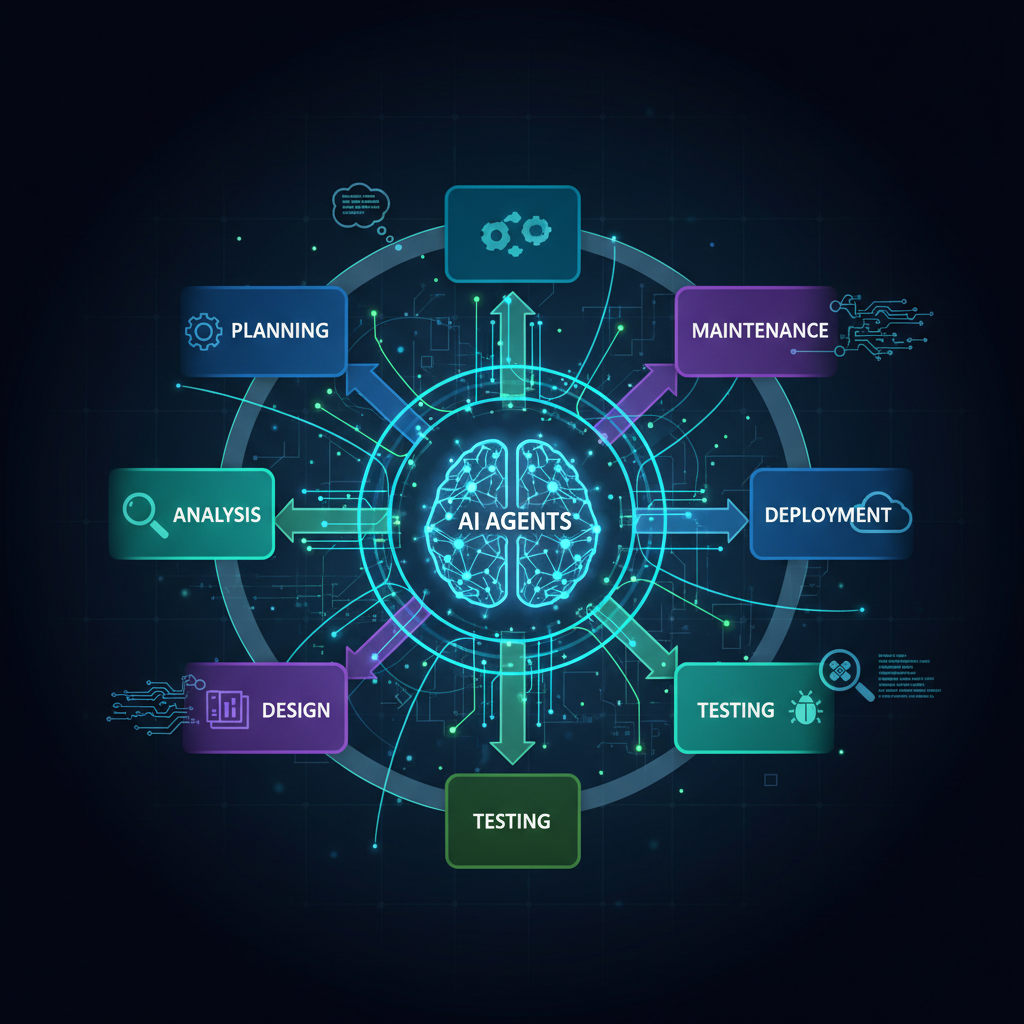
AI Agents: Revolutionizing the Software Development Lifecycle (SDLC)
The traditional SDLC struggles with modern software complexity. Discover how AI agents are ushering in an "Agentic SDLC," enabling systems to think, diagnose, and self-heal, paving the way for adaptive software.
The software development lifecycle (SDLC) has long been a domain of meticulous planning, manual intervention, and reactive problem-solving. From writing code to deploying and maintaining complex systems, human ingenuity has been the primary driver. However, as software systems grow exponentially in complexity – embracing microservices, distributed architectures, and intricate AI/ML models – the traditional SDLC is buckling under the strain. Enter the era of AI agents, poised to revolutionize how we build and manage software. This isn't just about automating tasks; it's about instilling systems with the ability to think, diagnose, and heal themselves. We're on the cusp of an Agentic SDLC that doesn't just generate code, but actively participates in its own well-being, leading to a future of self-healing and adaptive software.
The Unfolding Challenge: Complexity and Cost
Modern software is a labyrinth of interconnected services, ephemeral containers, and dynamic cloud environments. A single user request might traverse dozens of microservices, each with its own dependencies, configurations, and potential failure points. When something goes wrong, the symptoms are often far removed from the root cause. Traditional monitoring tools might flag an error, but the journey from symptom to diagnosis to remediation remains a time-consuming, labor-intensive, and often error-prone human endeavor.
The consequences are stark:
- High Mean Time To Resolution (MTTR): Every minute of downtime translates directly to lost revenue, reputational damage, and frustrated users.
- Developer Burnout: Constant on-call rotations, late-night debugging sessions, and the pressure to fix critical issues quickly take a toll.
- Escalating Costs: Manual debugging, incident response teams, and the opportunity cost of developers diverted from feature development are significant financial burdens.
This is where the vision of a self-healing and adaptive Agentic SDLC becomes not just aspirational, but an economic imperative. Imagine a system that doesn't just tell you something is broken, but understands why, proposes a fix, and even applies it, all with minimal human oversight.
The AI Agent Renaissance: Fueling Self-Healing
The concept of autonomous agents isn't new, but recent breakthroughs, particularly in Large Language Models (LLMs), have endowed them with unprecedented capabilities. These advancements are the bedrock of self-healing systems:
LLM-Powered Reasoning and Code Understanding
At the heart of the agentic revolution is the LLM's ability to process, understand, and generate human-like text and code. This translates directly into powerful capabilities for SDLC agents:
- Contextual Understanding: Agents can ingest vast, disparate datasets – logs, traces, metrics, code repositories, documentation, wikis, incident reports – and synthesize a coherent understanding of the system's state. An LLM can identify patterns across these data sources that a human might miss or take hours to uncover. For instance, correlating a spike in database latency with a recent deployment and a specific log message about a malformed query.
- Automated Root Cause Analysis (RCA): Traditional RCA often relies on predefined rules or human heuristics. LLMs can analyze error messages, stack traces, and system logs to hypothesize root causes with remarkable accuracy. They can go beyond simple pattern matching to infer the intent behind code and configuration changes, linking observed behavior to underlying logic flaws.
- Code Patch Generation: Perhaps one of the most transformative capabilities is the agent's ability to not just identify a problem, but to propose and even generate corrective code. This could range from a simple configuration change to a complex refactor or a security patch. Tools like GitHub Copilot are early indicators of this potential, assisting developers. Agentic systems take this a step further, generating patches autonomously based on a diagnosis.
Multi-Agent Architectures and Orchestration
A single, monolithic AI agent attempting to manage the entire SDLC would be unwieldy and inefficient. The emerging paradigm is one of multi-agent systems, where specialized agents collaborate to achieve complex goals.
- Specialized Roles: Imagine a "Monitoring Agent" constantly observing system health, a "Diagnosis Agent" performing RCA, a "Remediation Agent" crafting solutions, and a "Testing Agent" validating fixes. Each agent excels in its domain.
- Agent Orchestration Frameworks: Frameworks like AutoGen, CrewAI, and LangChain are critical enablers. They provide the scaffolding for agents to communicate, delegate tasks, and refine solutions iteratively. An orchestrator might assign a task to a Diagnosis Agent, which then requests data from a Monitoring Agent, and upon forming a hypothesis, delegates to a Remediation Agent.
- Feedback Loops and Learning: A crucial aspect of "adaptive" systems is the ability to learn. Agents can learn from past remediation attempts, both successes and failures. Reinforcement Learning from Human Feedback (RLHF) can be applied to agent actions, allowing them to refine their diagnostic accuracy and solution effectiveness over time, making them more robust and reliable.
Integration with Observability Stacks
Observability is the bedrock of understanding system behavior. AI agents elevate observability from passive data collection to active, intelligent interpretation.
- Semantic Monitoring: Beyond raw metrics (CPU usage, latency), agents can interpret the meaning of system behavior. They can correlate metrics from Prometheus, logs from Splunk, and traces from Datadog to understand the business impact of an anomaly, not just its technical manifestation. For example, an agent might infer that a slight increase in database latency is critical because it affects a core customer checkout flow, while a similar latency spike in a background batch job is less urgent.
- Automated Tracing and Profiling: When an anomaly is detected, agents could dynamically instrument code, adjust logging levels, or initiate targeted profiling sessions to gather more granular diagnostic information, much like a human engineer would during an incident.
Autonomous Testing and Test Repair
Testing is a cornerstone of quality, but test suites are notoriously fragile and expensive to maintain. Agents can transform this landscape:
- Self-Evolving Test Suites: As code changes, agents can analyze the modifications, identify affected areas, and either generate new test cases or adapt existing ones to prevent regressions, ensuring test coverage remains high.
- Automated Test Healing: UI or API changes frequently break existing tests. Agents can analyze the failure (e.g., comparing screenshots, parsing DOM changes), identify the breaking change (e.g., a changed CSS selector, a renamed API endpoint), and automatically update the test code to reflect the new reality, then re-run the tests to verify the fix.
Practical Applications: From Theory to Tangible Impact
The vision of self-healing systems isn't confined to academic papers. Practical applications are emerging across the SDLC, offering significant advantages to practitioners and organizations.
1. Automated Incident Response (Production)
This is perhaps the most impactful and immediate application, directly addressing MTTR and operational costs.
- Scenario: A critical microservice,
PaymentGateway, suddenly starts returning 500 errors, impacting customer transactions. - Agentic Solution:
- Monitoring Agent: Detects a sudden surge in 5xx errors for
PaymentGatewayvia APM tools (e.g., Datadog, New Relic) and alerts the system. - Diagnosis Agent:
- Ingests recent logs from
PaymentGatewayand its dependencies. - Analyzes traces to identify the specific component or function failing.
- Correlates the incident with recent deployments, configuration changes, or upstream service outages.
- Uses an LLM to analyze stack traces and error messages, hypothesizing the root cause – perhaps a misconfigured database connection string introduced in the last deployment.
- Example output from Diagnosis Agent: "Hypothesis:
PaymentGatewayservice failing due toDB_CONNECTION_STRINGenvironment variable mismatch withpayments-db-v2afterdeployment-20231027-01. Error message:SQLSTATE[HY000]: [2002] Connection refused."
- Ingests recent logs from
- Remediation Agent:
- Based on the diagnosis, proposes a solution: rollback
deployment-20231027-01forPaymentGatewayto the previous stable version. - Alternatively, if the issue is a simple configuration, it might propose updating the
DB_CONNECTION_STRINGvia a configuration management tool. - Example output from Remediation Agent: "Proposed Action: Rollback
PaymentGatewayservice todeployment-20231026-03. Estimated MTTR reduction: 80%."
- Based on the diagnosis, proposes a solution: rollback
- Human-in-the-Loop (HITL): Initially, the system might require human approval for critical actions. The proposed rollback is presented to an on-call engineer with a clear explanation and justification.
- Execution Agent: Upon approval, executes the rollback command via the CI/CD pipeline or Kubernetes API.
- Verification Agent: Automatically runs a suite of critical health checks and synthetic transactions against
PaymentGatewayto confirm the resolution. If successful, it closes the incident.
- Monitoring Agent: Detects a sudden surge in 5xx errors for
2. Proactive Development-Time Bug Fixing
Shifting left with AI agents means catching and fixing issues before they even reach testing or production.
- Scenario: A developer submits a Pull Request (PR) with a new feature for a
UserService. The code includes a common anti-pattern: direct database access within a controller, bypassing the service layer. - Agentic Solution:
- Code Review Agent: Integrates with the SCM (e.g., GitHub). When a PR is opened, it analyzes the diff.
- Static Analysis & LLM Reasoning: Combines traditional static analysis (e.g., for security vulnerabilities, performance issues) with LLM-based reasoning to understand the intent and architectural implications of the code. It identifies the direct database access as an anti-pattern for the project's established architecture.
- Suggestion Agent: Adds a comment to the PR, explaining the anti-pattern and proposing a refactored code snippet.
Reasoning: Encapsulates business logic, improves testability, and maintains separation of concerns.markdown
- Testing Agent (Optional): If the agent identifies a potential bug (e.g., an edge case not covered), it could even generate a new unit test to cover that specific scenario and add it to the PR.
3. Autonomous Test Suite Maintenance
Maintaining large test suites is a significant overhead. Agents can automate the most tedious aspects.
- Scenario: The UI team re-designs the login page, changing button IDs and form field selectors. This breaks 15 existing end-to-end (E2E) UI tests.
- Agentic Solution:
- Failure Analysis Agent: When E2E tests fail in CI/CD, this agent analyzes the test reports, error messages (e.g.,
ElementNotFoundException), and potentially screenshots or DOM snapshots taken at the time of failure. - Repair Agent:
- Compares the failed test's expected DOM structure (from a previous successful run) with the current DOM structure.
- Uses visual recognition and DOM analysis techniques to identify updated selectors (e.g., an old button ID
login-btnis nowprimary-login-button). - Leverages an LLM to understand the context of the test and propose the most likely correct new selector.
- Example: "Test
Login_ValidCredentials_Successfailed atdriver.findElement(By.id("login-btn")). Analysis suggestslogin-btnhas been renamed toprimary-login-button. Proposed fix: Update selector."
- Update Agent: Automatically generates a patch for the test code, updating the broken selectors.
diff
- Verification Agent: Re-runs the affected tests with the proposed patch. If they pass, the agent can create a new PR with the test fix, ready for review and merge.
- Failure Analysis Agent: When E2E tests fail in CI/CD, this agent analyzes the test reports, error messages (e.g.,
4. Self-Optimizing Infrastructure
Beyond code, agents can manage and optimize the underlying infrastructure.
- Scenario: A critical database query,
GET /api/products, experiences a performance degradation under peak load, leading to increased latency for users. - Agentic Solution:
- Performance Monitoring Agent: Detects the slowdown in the
GET /api/productsendpoint and identifies the associated database query as the bottleneck. - Optimization Agent:
- Analyzes the database's query plan for the problematic query.
- Examines database logs for slow queries and missing indexes.
- Consults the database schema and existing indexes.
- Uses an LLM to reason about potential optimizations, such as adding a new index to a frequently filtered column or suggesting a query rewrite.
- Example: "Query
SELECT * FROM products WHERE category = ? AND price > ?is performing a full table scan. Recommendation: Add index onproducts.categoryandproducts.price."
- Deployment Agent:
- Creates a change request for the proposed index addition.
- Applies the index in a staging environment first.
- Monitors performance metrics in staging to validate the improvement.
- If successful, it then initiates the deployment of the index to production, potentially using a phased rollout strategy.
- Verification Agent: Continuously monitors the
GET /api/productsendpoint's latency and database query performance in production to confirm the optimization's effectiveness.*
- Performance Monitoring Agent: Detects the slowdown in the
Challenges and the Path Forward
While the promise is immense, realizing a fully self-healing and adaptive Agentic SDLC comes with significant challenges:
- Trust and Safety: The paramount concern is ensuring agents don't introduce new bugs, security vulnerabilities, or break production systems. Robust validation, rollback mechanisms, and strict guardrails are non-negotiable.
- Explainability (XAI): For humans to trust autonomous agents, their decisions cannot be black boxes. Agents must provide clear, auditable justifications for their diagnoses and proposed actions, fostering transparency.
- Contextual Understanding: Generic AI models aren't enough. Agents need deep, domain-specific understanding of an organization's unique business logic, architectural patterns, and historical context. This requires effective knowledge representation, retrieval-augmented generation (RAG), and continuous learning from organizational data.
- Computational Cost: Running complex LLM-powered agents continuously, especially for real-time monitoring and remediation, can be computationally expensive. Optimizing agent architectures and leveraging smaller, specialized models will be crucial.
- Ethical Considerations and Accountability: If an autonomous agent introduces a critical bug or security flaw, who is responsible? Establishing clear lines of accountability and ethical guidelines for agent behavior is vital.
- Learning and Adaptation: How do agents learn from successes and failures across diverse, evolving software systems without being explicitly reprogrammed? This requires sophisticated learning mechanisms that can generalize across different contexts and adapt to new technologies.
Conclusion: The Dawn of Autonomous Software Engineering
The "Self-Healing and Adaptive Agentic SDLC" is not merely an incremental improvement; it represents a fundamental paradigm shift in how we conceive, develop, and operate software. It moves us beyond reactive human intervention to proactive, intelligent, and self-correcting systems.
For AI practitioners, this field offers fertile ground for innovation, blending cutting-edge AI research with the pragmatic demands of software engineering. For software developers and operations teams, it promises a future where mundane, repetitive, and stressful tasks are handled by intelligent agents, freeing up human talent to focus on creativity, innovation, and strategic problem-solving.
While full autonomy is a journey, not a destination, the practical applications emerging today are already demonstrating significant value. By embracing multi-agent architectures, leveraging the power of LLMs, and integrating deeply with observability, we are building systems that are not just resilient, but truly adaptive – capable of evolving and healing themselves, ushering in a new era of autonomous software engineering. The future of SDLC is not just automated; it's intelligent, self-aware, and self-healing.