Federated Learning for On-Device AI in Resource-Constrained IoT Environments
Explore how Federated Learning (FL) revolutionizes AI deployment on IoT devices. Discover its benefits for distributed intelligence, privacy preservation, and efficient resource utilization in edge computing, addressing challenges of traditional cloud-centric models.
Unlocking Distributed Intelligence: Federated Learning for On-Device AI in Resource-Constrained IoT Environments
The digital world is expanding at an unprecedented pace, with billions of interconnected devices forming the vast network we call the Internet of Things (IoT). From smart home sensors and wearable health trackers to industrial machinery and autonomous vehicles, these devices are generating an avalanche of data at the "edge" of our networks. This data holds immense potential for driving intelligent applications, but harnessing it effectively presents a unique set of challenges. Traditional cloud-centric AI models, which rely on centralizing data for training, are often ill-suited for the realities of the IoT landscape. This is where Federated Learning (FL) steps in, offering a revolutionary paradigm shift that promises to unlock distributed intelligence directly on resource-constrained IoT devices, all while safeguarding privacy and optimizing resource utilization.
The Imperative for Edge AI: Why Centralized Models Fall Short in IoT
Before diving into Federated Learning, it's crucial to understand the fundamental reasons why the IoT environment necessitates a new approach to AI training and deployment:
- Explosive Growth and Data Deluge: The sheer volume of IoT devices is staggering. Each sensor, camera, and actuator contributes to an ever-growing pool of data. Transmitting all this raw data to a central cloud for processing and training is becoming logistically and economically unfeasible.
- Paramount Privacy and Regulatory Compliance: Many IoT applications deal with highly sensitive personal or proprietary information. Think about health data from wearables, video feeds from smart cameras, or operational data from industrial facilities. Sending this raw data to the cloud raises significant privacy concerns and legal hurdles (e.g., GDPR, CCPA). Data localization and minimization are no longer just best practices; they are often legal mandates.
- Network Constraints: Bandwidth, Latency, and Cost: IoT deployments frequently operate in environments with limited or intermittent network connectivity. Uploading massive datasets for continuous training consumes significant bandwidth, introduces unacceptable latency for real-time applications (like autonomous driving or industrial control), and incurs substantial cloud egress costs.
- Computational Disparity: Edge vs. Cloud: While edge devices are becoming increasingly powerful, they still operate under strict computational constraints compared to cloud data centers. They typically have limited CPU/GPU power, memory, and battery life. This means that complex AI models trained in the cloud often need to be heavily optimized or re-architected for on-device inference, let alone on-device training.
- Real-time Decision Making: Many critical IoT applications demand immediate responses. An autonomous vehicle cannot wait for data to travel to the cloud, be processed, and then receive an instruction back. Decisions must be made locally, in milliseconds.
These challenges highlight a clear need: AI must move closer to where the data is generated – to the edge. However, simply deploying pre-trained models to the edge only solves the inference problem. To enable continuous learning, adaptation, and personalization without compromising the core principles of privacy and efficiency, a more sophisticated approach is required: Federated Learning.
Demystifying Federated Learning: A Collaborative Approach to AI
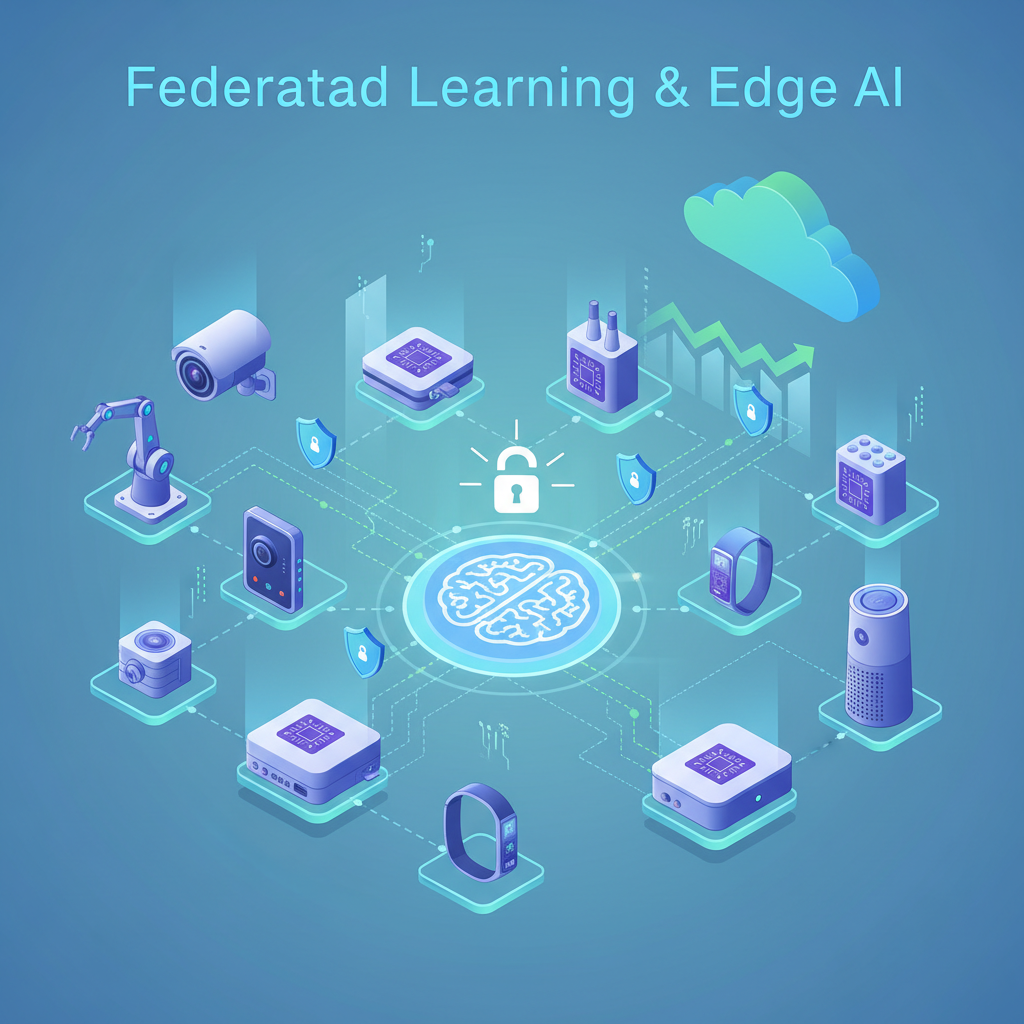
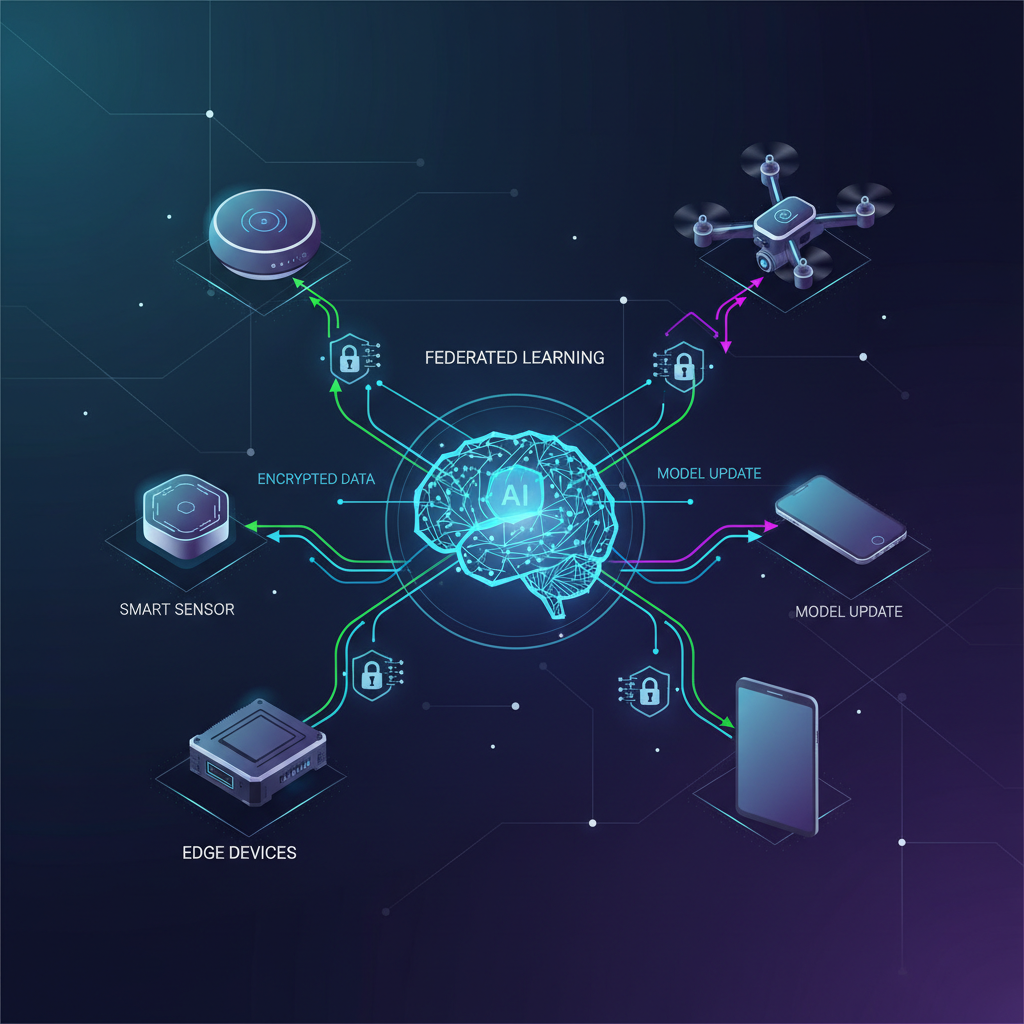
At its core, Federated Learning is a distributed machine learning paradigm that enables multiple clients (e.g., IoT devices) to collaboratively train a shared global model without exchanging their raw data. Instead of data moving to the model, the model (or parts of it) moves to the data.
Here's how the typical FL cycle unfolds:
- Initialization: A central server initializes a global model (e.g., a neural network) and sends it to a selected subset of participating IoT devices.
- Local Training: Each selected device trains the received model locally using its own private dataset. This training process generates local model updates (e.g., gradients or updated weights). Crucially, the raw data never leaves the device.
- Secure Aggregation: Only the model updates (not the raw data) are sent back to the central server. These updates are typically much smaller than the raw data itself.
- Global Model Update: The central server aggregates these local updates from all participating devices to compute a new, improved global model. This aggregation process often involves averaging the updates (as in the popular FedAvg algorithm).
- Iteration: The newly updated global model is then sent back to the devices for the next round of local training, and the cycle repeats until the model converges or a predefined number of rounds are completed.
This iterative process allows the global model to learn from the collective experience of all devices while maintaining the privacy of individual data points. It's a powerful shift from "data centralization" to "model centralization," offering a compelling solution for the privacy and resource constraints of IoT.
Navigating the Nuances: Key Challenges and Cutting-Edge Solutions in IoT-Edge FL
While FL offers a compelling vision, its application in the diverse and challenging IoT landscape introduces specific complexities. Researchers and practitioners are actively developing innovative solutions to address these:
1. Heterogeneity: The Double-Edged Sword of Diversity
IoT environments are inherently heterogeneous, posing two primary challenges for FL:
-
Statistical Heterogeneity (Non-IID Data): Data distributions vary significantly across IoT devices. A smart camera in a bustling city intersection will capture vastly different patterns than one in a quiet residential street. A medical wearable on an elderly patient will record different physiological data than one on a young athlete. This "non-Independent and Identically Distributed" (non-IID) data can cause models to diverge or perform poorly if not handled correctly.
- Recent Solutions:
- Personalization Techniques: Approaches like FedPer, pFedMe, and FedProx allow devices to learn personalized models while still benefiting from the collective knowledge of the global model. This often involves learning a shared feature extractor and device-specific output layers, or regularizing local updates towards the global model.
- Meta-Learning: Meta-learning frameworks can enable devices to quickly adapt the global model to their specific data distributions with minimal local training.
- Multi-Task Learning: Framing the problem as a multi-task learning scenario, where each device represents a task, can help the model learn shared representations while accommodating individual differences.
- Recent Solutions:
-
System Heterogeneity: IoT devices exhibit wide variations in computational power, memory, battery life, and network connectivity. Some devices might be powerful edge gateways, while others are tiny, battery-powered sensors.
- Recent Solutions:
- Adaptive Client Selection: Instead of randomly selecting devices, the server can prioritize clients with sufficient resources, stable network connections, or those holding more "valuable" (e.g., novel or diverse) data.
- Asynchronous FL: Traditional FL is synchronous, waiting for all selected clients. Asynchronous FL allows devices to contribute updates at their own pace, reducing idle time and accommodating slower devices.
- Model Compression Techniques: Techniques like quantization (reducing the precision of model weights, e.g., from 32-bit floats to 8-bit integers) and pruning (removing less important connections or neurons) significantly reduce model size, making them suitable for resource-constrained devices and reducing communication overhead.
- Recent Solutions:
2. Communication Overhead: The Bandwidth Bottleneck
Despite sending only model updates, communication can still be a significant bottleneck, especially for large models or in environments with poor network connectivity.
- Recent Solutions:
- Communication Compression:
- Quantization: As mentioned, reducing precision not only helps with on-device deployment but also shrinks the size of transmitted updates.
- Sparsification: Sending only the most significant gradients or weight updates, effectively setting small updates to zero.
- Differential Compression: Sending only the difference between the current local model and the previous global model.
- Federated Averaging (FedAvg) Variants: Optimizations to the FedAvg algorithm itself, such as increasing the number of local training epochs before sending updates (reducing communication rounds), or using more sophisticated aggregation strategies that are less sensitive to communication frequency.
- Hierarchical FL (HFL): A particularly promising approach for IoT. Instead of all devices communicating directly with a central cloud server, intermediate aggregators (e.g., edge gateways, local servers) are introduced. Devices communicate with their local gateway, which then aggregates updates and sends a single, compressed update to the central server. This reduces long-haul communication and leverages local network capabilities.
- Communication Compression:
3. Security and Privacy Enhancements: Beyond Inherent Privacy
While FL inherently protects raw data, model updates themselves can potentially leak sensitive information through sophisticated inference attacks. Enhancing privacy and security is paramount.
- Recent Solutions:
- Differential Privacy (DP): Adding carefully calibrated random noise to model updates before sending them to the server. This provides a mathematical guarantee against individual data reconstruction, albeit often at the cost of some model accuracy.
- Homomorphic Encryption (HE): A cryptographic technique that allows computations to be performed on encrypted data without decrypting it. In FL, this means the central server can aggregate encrypted model updates without ever seeing the unencrypted values, providing strong privacy guarantees even from the aggregator. However, HE is computationally intensive.
- Secure Multi-Party Computation (SMC): Distributes the aggregation process among multiple non-colluding parties. No single party can reconstruct the individual updates, and the global model is computed collaboratively.
- Blockchain for FL: Leveraging blockchain's decentralized, immutable ledger to record and verify model updates, incentivize participation, and ensure transparency and accountability in the FL network. This can also help in securing the aggregation process and managing client reputations.
4. Resource Management & Energy Efficiency: Sustaining On-Device Training
Training on-device consumes computational resources and battery power, which are often scarce in IoT.
- Recent Solutions:
- Dynamic Resource Allocation: Intelligent scheduling systems that determine when and which devices should participate in training rounds based on their current battery level, network conditions, and computational load.
- Energy-Aware Scheduling: Prioritizing training during periods of charging or when devices have excess energy.
- Lightweight Model Architectures: Designing neural network architectures specifically for edge inference and training, such as MobileNets, EfficientNets, and TinyML models, which offer excellent performance with minimal computational footprint.
5. Deployment and Orchestration: Managing the Distributed Beast
Managing FL across potentially millions of diverse IoT devices presents significant operational challenges.
- Recent Solutions:
- Specialized FL Frameworks: Tools like TensorFlow Federated (TFF) and PyTorch Mobile / PySyft provide robust APIs and abstractions for simulating, experimenting with, and deploying FL systems.
- Edge Orchestration Platforms: Existing edge computing platforms are integrating FL capabilities, allowing for seamless deployment, monitoring, and management of federated training tasks across a distributed fleet of devices. These platforms handle client selection, model distribution, update aggregation, and security.
Real-World Impact: Practical Applications and Use Cases
The theoretical advancements in FL for IoT are rapidly translating into tangible benefits across various sectors:
-
Smart Cities:
- Traffic Management: Vehicles or roadside sensors collaboratively train models to predict traffic congestion, identify accident hotspots, or optimize traffic light timings. Raw GPS data or video feeds remain local, while the collective intelligence improves urban mobility.
- Environmental Monitoring: Distributed air quality sensors can collaboratively learn to predict pollution patterns or identify anomaly sources without sending sensitive location-specific data to a central cloud.
- Public Safety: Smart cameras deployed in public spaces can collaboratively detect anomalies (e.g., abandoned packages, unusual crowds, falls) without streaming all video feeds to a central server, significantly enhancing privacy and reducing bandwidth requirements.
-
Healthcare & Wearables:
- Personalized Health Monitoring: Smartwatches, continuous glucose monitors, and other medical sensors can train models on an individual's device to detect anomalies (e.g., arrhythmia, sleep disorders, diabetic episodes). This keeps highly sensitive health data private and enables hyper-personalized alerts and insights.
- Collaborative Disease Research: Hospitals and clinics can collectively train models for disease prediction, diagnosis, or drug efficacy analysis using their patient data, without ever sharing individual patient records. This accelerates medical research while adhering to strict privacy regulations.
-
Industrial IoT (IIoT):
- Predictive Maintenance: Machines in different factories or even different parts of the same factory can collaboratively train models to predict equipment failures. Each machine learns from its own operational data, sharing only aggregated insights (model updates) to improve the global predictive model, thus keeping proprietary operational data within each facility.
- Quality Control: Edge cameras on production lines can collaboratively learn to detect manufacturing defects. As new defect types emerge, the models can be updated across the network without sending sensitive images of manufacturing processes to a central cloud.
-
Autonomous Vehicles:
- Collaborative Perception: Fleets of autonomous vehicles can share model updates to improve object detection, lane keeping, or pedestrian recognition. This allows models to learn from diverse driving conditions and scenarios experienced by the entire fleet, without exchanging massive raw sensor data streams.
- Personalized Driving Assistants: In-car systems can learn individual driver preferences, habits, and common routes locally, providing highly personalized navigation and infotainment experiences while safeguarding user privacy.
-
Smart Homes & Consumer Electronics:
- Voice Assistants: Improving speech recognition and natural language understanding models based on user interactions directly on devices like smart speakers or smartphones, without uploading audio recordings or transcripts.
- Smart Keyboards: Learning personalized text predictions, auto-corrections, and emoji suggestions directly on the user's device, adapting to individual typing styles and vocabulary.
Essential Tools and Frameworks for Your FL Journey
For practitioners and researchers eager to dive into Federated Learning, several robust frameworks are available:
- TensorFlow Federated (TFF): Developed by Google, TFF is an open-source framework designed for both research and production deployment of federated learning. It provides a high-level API for expressing FL computations and a low-level API for flexible customization.
- PyTorch Mobile / PySyft (OpenMined): While PyTorch Mobile focuses on deploying PyTorch models to mobile and edge devices, PySyft (from the OpenMined community) extends PyTorch with powerful tools for privacy-preserving AI, including federated learning, differential privacy, and secure multi-party computation.
- Intel OpenFL: An open-source Python-based framework from Intel, specifically designed for enterprise-grade federated learning. It focuses on flexibility, security, and ease of deployment in production environments.
- IBM Federated Learning: IBM offers enterprise-grade solutions and research in federated learning, often integrated with their cloud platforms and AI services, focusing on security and compliance for sensitive data.
These tools provide the foundational building blocks to experiment with, implement, and deploy federated learning solutions in diverse IoT contexts.
The Future is Distributed: A Concluding Perspective
Federated Learning for on-device AI in resource-constrained IoT environments is more than just a buzzword; it's a fundamental shift in how we conceive and deploy artificial intelligence. It represents a powerful confluence of cutting-edge research in distributed systems, privacy-preserving machine learning, and edge computing. By enabling AI models to learn collaboratively from decentralized data sources without compromising privacy or overwhelming network infrastructure, FL is poised to unlock the full potential of the IoT.
For AI practitioners and enthusiasts, this field offers a rich tapestry of challenges and opportunities. Delving into the intricacies of statistical and system heterogeneity, mastering privacy-enhancing technologies, and optimizing communication strategies are essential for building the next generation of intelligent, ethical, and efficient IoT applications. The journey towards truly distributed intelligence at the edge has just begun, and its impact will resonate across virtually every sector, shaping a future where AI is not only powerful but also private, resilient, and ubiquitous.