Federated Learning: On-Device AI for Resource-Constrained IoT at the Edge
Explore how Federated Learning revolutionizes AI deployment in IoT, moving intelligence to the edge. This paradigm shift addresses privacy, bandwidth, and energy challenges by enabling on-device learning in resource-constrained environments.
The promise of Artificial Intelligence has long been tied to the cloud – vast data centers processing petabytes of information to train ever more sophisticated models. However, as AI permeates every facet of our lives, from smart homes to industrial machinery, a fundamental tension emerges: the desire for intelligent, real-time decision-making clashes with the realities of data privacy, network bandwidth, and energy consumption at the "edge." This is where the convergence of the Internet of Things (IoT), Edge Computing, and AI finds its most elegant solution: Federated Learning for On-Device AI in Resource-Constrained IoT Environments.
This isn't just a niche academic pursuit; it's a paradigm shift that redefines how we build and deploy intelligent systems, moving from a centralized "collect-then-train" model to a distributed, privacy-preserving "learn-where-the-data-lives" approach.
The Inevitable Collision: Why Centralized AI Fails at the Edge
Before diving into Federated Learning, it's crucial to understand the inherent challenges that traditional, centralized AI deployment faces when confronted with the unique characteristics of IoT devices:
-
Privacy and Regulatory Hurdles: IoT devices often collect highly sensitive personal data (health metrics from wearables, voice commands from smart speakers, surveillance footage) or proprietary industrial data. Uploading this raw data to a central cloud server creates significant privacy risks and can violate stringent regulations like GDPR, HIPAA, or industry-specific compliance standards. Users and organizations are increasingly wary of relinquishing control over their data.
-
Bandwidth Bottlenecks and Latency: Imagine millions of smart cameras simultaneously streaming high-definition video to the cloud for anomaly detection, or autonomous vehicles constantly uploading sensor data. The sheer volume of data would overwhelm network infrastructure, leading to prohibitive costs, significant latency, and unreliable performance. For critical applications like industrial control or autonomous navigation, real-time decisions cannot wait for data to travel to a distant cloud and back.
-
Energy Constraints: Many IoT devices are battery-powered and operate in remote locations. Data transmission, especially over cellular networks, is a major power drain. Minimizing data movement is paramount for extending battery life and reducing maintenance overhead.
-
Data Heterogeneity (Non-IID Data): Data generated by IoT devices is rarely uniformly distributed (Independent and Identically Distributed, or IID). A smart thermostat in a desert climate will have very different usage patterns and sensor readings than one in a temperate zone. A factory machine in one plant might operate differently from an identical one in another due to local conditions or maintenance schedules. Centralized models trained on an aggregate dataset might perform poorly on individual, idiosyncratic devices.
-
Security Risks: Centralized data lakes become attractive targets for cyberattacks. A breach in a central repository can expose vast quantities of sensitive information from countless devices.
These challenges highlight the need for a fundamentally different approach to AI, one that respects data locality, minimizes communication, and operates efficiently within the constraints of the edge.
Federated Learning: The Distributed Intelligence Solution
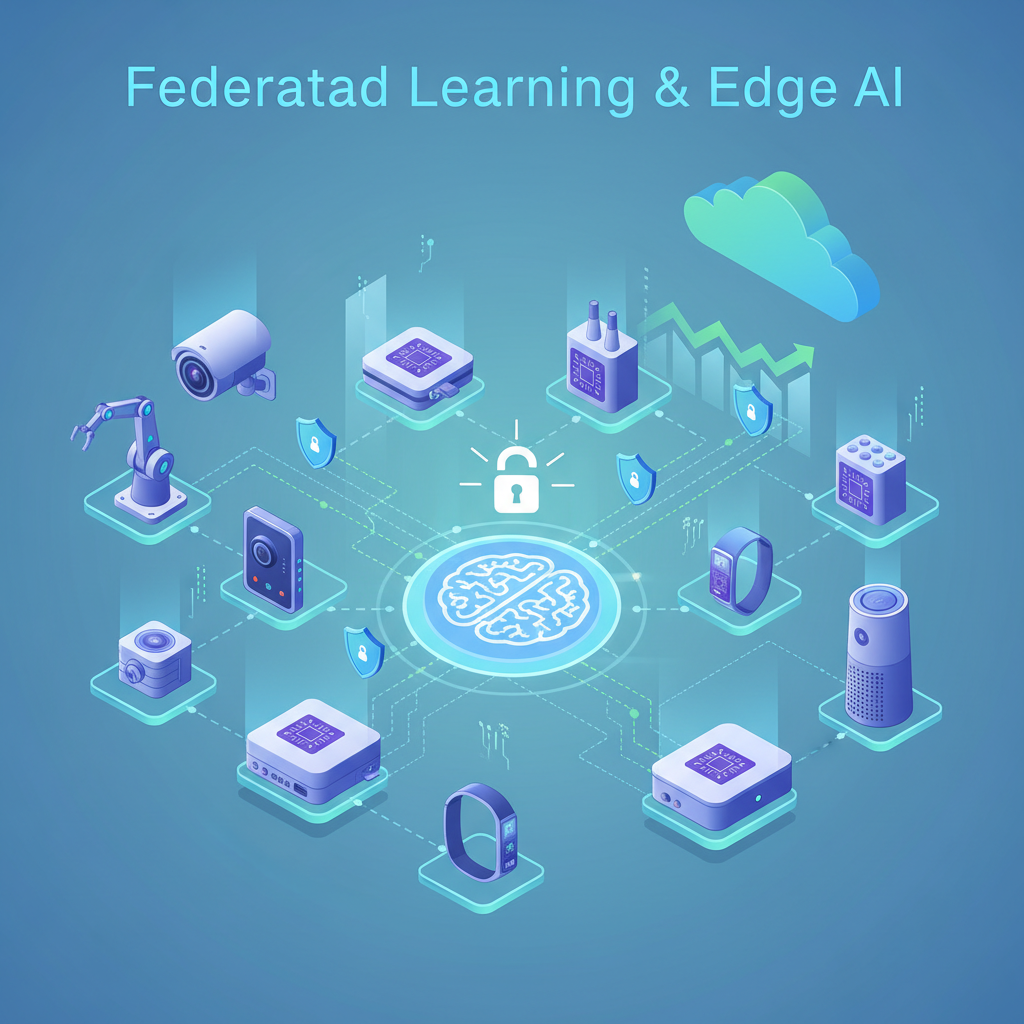
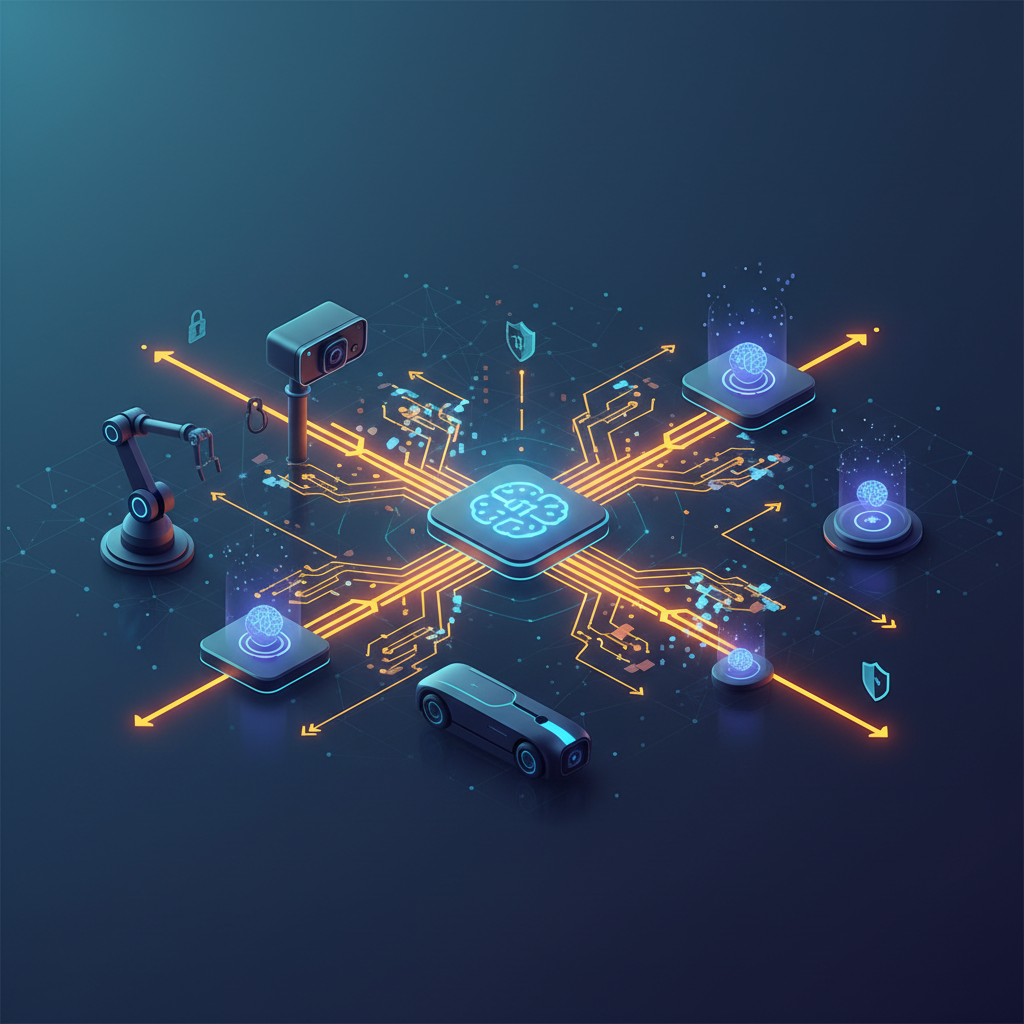
Federated Learning (FL) emerges as a powerful solution by flipping the traditional AI training paradigm on its head. Instead of bringing all the data to a central server, FL brings the model to the data.
How Federated Learning Works (Simplified):
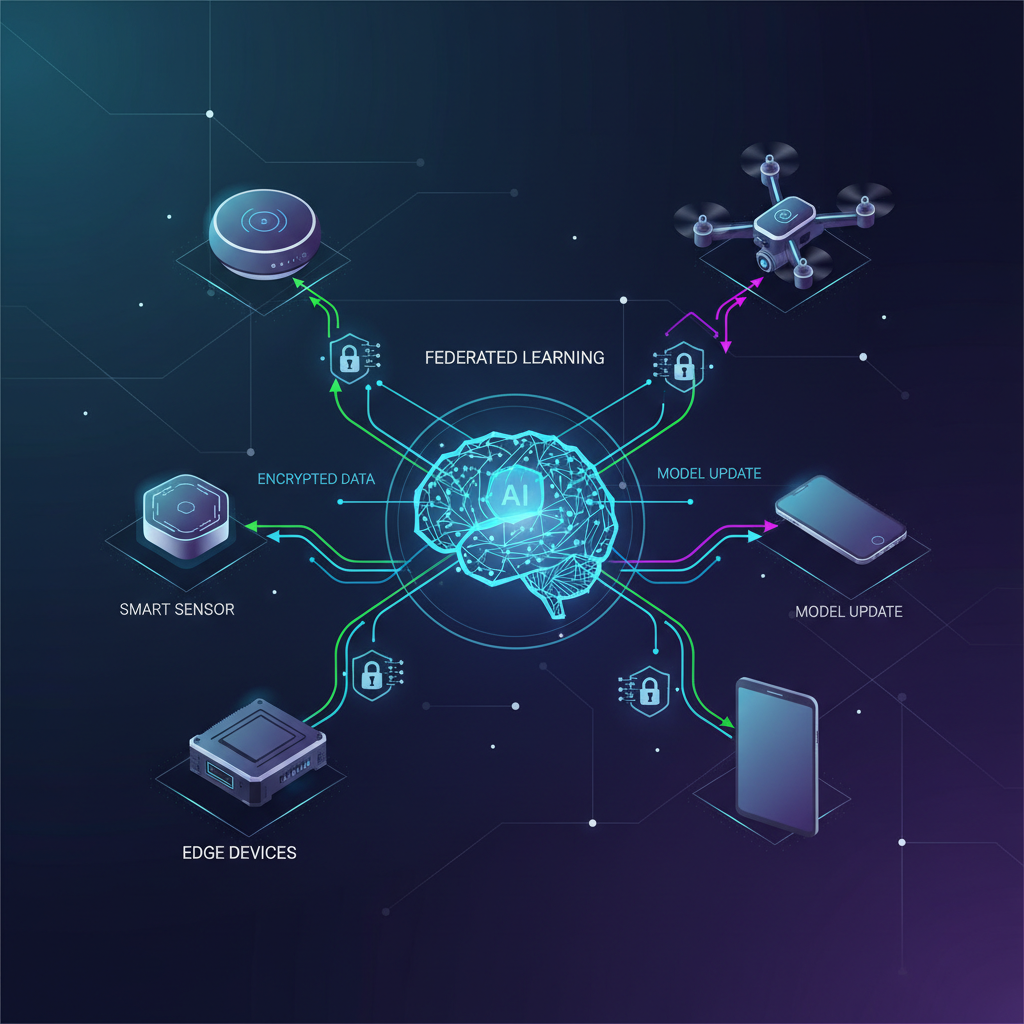
- Global Model Distribution: A central server (or orchestrator) initializes a global machine learning model (e.g., a neural network) and distributes it to a selected group of participating IoT devices.
- Local Training: Each device trains this model locally using its own private, on-device data. Crucially, the raw data never leaves the device.
- Model Update Transmission: Instead of sending raw data, each device computes and sends back only the model updates (e.g., the changes in the model's weights and biases) to the central server. These updates are typically much smaller than the raw data itself.
- Global Model Aggregation: The central server receives model updates from multiple devices, aggregates them (e.g., by averaging them), and creates a new, improved global model.
- Iteration: This aggregated global model is then sent back to the devices for the next round of local training, and the process repeats.
This iterative process allows a shared global model to learn from the collective experience of many devices without ever directly accessing their private data.
Diving Deeper: Technical Pillars of Federated Learning in IoT
The elegance of FL masks a significant amount of technical complexity, especially when applied to resource-constrained IoT environments. AI practitioners need to grapple with several key areas:
1. Model Compression and Optimization for Edge Devices
Before FL even begins, the initial global model must be small and efficient enough to run on resource-constrained IoT devices. This involves techniques like:
- Quantization: Reducing the precision of model weights (e.g., from 32-bit floating point to 8-bit integers or even binary) to decrease model size and speed up inference.
- Pruning: Removing less important connections or neurons from a neural network without significantly impacting performance.
- Knowledge Distillation: Training a smaller "student" model to mimic the behavior of a larger, more complex "teacher" model.
- Efficient Architectures: Designing models specifically for edge deployment, such as MobileNet, EfficientNet, or TinyML models.
These techniques ensure that local training and inference are feasible on devices with limited memory, processing power, and energy budgets.
2. Distributed Optimization Algorithms
The core of FL lies in its aggregation algorithms. The most common is Federated Averaging (FedAvg), where the server simply averages the model updates received from participating devices. However, FedAvg has limitations, especially with non-IID data. More advanced algorithms address these challenges:
- FedProx: Adds a proximal term to the local objective function to regularize local updates, preventing devices from drifting too far from the global model, which helps with non-IID data.
- SCAFFOLD: Addresses client drift by using control variates to correct for differences in local data distributions, leading to faster convergence and better performance on heterogeneous data.
- FedAdam/FedYogi/FedAdagrad: Adapting adaptive optimization techniques (like Adam) for the federated setting to improve convergence speed and stability.
Understanding the convergence properties and computational overhead of these algorithms is crucial for selecting the right approach for a given IoT application.
3. Communication Efficiency
Minimizing the data transferred between devices and the server is paramount for IoT. Techniques include:
- Sparsification: Only sending a subset of the model updates (e.g., only the largest gradients) to reduce payload size.
- Quantization of Gradients: Similar to model quantization, reducing the precision of the transmitted model updates.
- Asynchronous Updates: Allowing devices to send updates at their own pace, rather than waiting for a synchronized round, which can be beneficial in unreliable IoT networks.
- Secure Aggregation: Using cryptographic techniques to aggregate updates without the server ever seeing individual device updates, further enhancing privacy.
4. Handling Data Heterogeneity (Non-IID Data)
This is perhaps the biggest challenge for FL in IoT. If devices have vastly different data distributions, a global model trained via simple averaging might not perform well for any individual device, or it might converge slowly. Solutions include:
- Personalization Techniques: Instead of a single global model, FL can be used to train a global base model, which is then fine-tuned locally on each device using its unique data, creating personalized models.
- Clustering: Grouping devices with similar data distributions and training separate federated models for each cluster.
- Meta-Learning Approaches: Training a model that can quickly adapt to new, unseen data distributions, making it more robust to heterogeneity.
5. Privacy-Preserving Techniques Beyond Data Locality
While FL inherently keeps raw data on the device, the model updates themselves could potentially leak information about the local data. To further enhance privacy:
- Differential Privacy (DP): Adding carefully calibrated noise to the model updates before sending them to the server. This provides a quantifiable privacy guarantee, making it extremely difficult to infer individual data points from the aggregated updates.
- Secure Multi-Party Computation (SMC): Cryptographic protocols that allow multiple parties to jointly compute a function (like model aggregation) over their private inputs without revealing those inputs to each other or to a central server.
- Homomorphic Encryption (HE): A powerful cryptographic technique that allows computations to be performed on encrypted data without decrypting it. This could allow the server to aggregate encrypted model updates, further bolstering privacy.
These advanced techniques add computational overhead but offer robust privacy guarantees essential for sensitive applications.
6. System Design and Orchestration
Deploying FL at scale in IoT requires robust system design:
- Device Selection: How to select which devices participate in each training round, considering factors like battery level, network connectivity, and data availability.
- Fault Tolerance: Handling device disconnections, failures, and slow participants.
- Scalability: Managing hundreds, thousands, or even millions of devices.
- Model Versioning and Rollback: Ensuring smooth updates and the ability to revert to previous model versions if issues arise.
- Integration with Edge Orchestration Platforms: Leveraging platforms like KubeEdge or OpenYurt to manage containerized FL workloads on edge devices.
7. Security Considerations
FL is not immune to security threats. Malicious participants could try to poison the global model by sending deliberately corrupted updates, or infer private data from aggregated updates. Defenses include:
- Robust Aggregation Algorithms: Techniques that are resilient to outliers or malicious updates.
- Anomaly Detection: Identifying and excluding suspicious device updates.
- Verifiable FL: Cryptographic methods to ensure the integrity of local training and updates.
Practical Applications Across Industries
The technical capabilities of FL translate into transformative practical applications across various sectors:
-
Smart Homes and Cities:
- Personalized Anomaly Detection: Your smart home hub learns your unique energy consumption patterns, security routines, or device usage on your device. It can then detect unusual activity (e.g., lights on when no one is home, unusual door sensor activity) without sending your private daily habits to a cloud server.
- Predictive Maintenance for Appliances: Washing machines or HVAC systems can learn their own operational characteristics and predict failures locally, notifying you or service providers before a breakdown, all while keeping operational data private.
- Traffic Flow Optimization (Smart Cities): Traffic cameras or sensors can collaboratively learn optimal traffic light timings or identify congestion patterns without transmitting raw vehicle data or individual movements to a central authority.
-
Healthcare:
- Wearable Health Monitoring: Smartwatches or medical patches can train predictive models for early disease detection (e.g., arrhythmia, glucose spikes) using an individual's biometric data on the device. This maintains patient privacy while improving diagnostic accuracy and enabling personalized health insights.
- Medical Imaging Analysis (Edge Hospitals): Hospitals can collaboratively train AI models on medical images (X-rays, MRIs) to improve diagnostic precision without sharing sensitive patient scans across institutional boundaries.
-
Industrial IoT (IIoT) and Manufacturing:
- Predictive Maintenance for Machinery: Individual factory machines or production lines can train models on their proprietary sensor data (vibration, temperature, pressure) to predict equipment failure. This keeps sensitive operational data within the factory, preventing competitors from gaining insights into production processes.
- Quality Control: Cameras on assembly lines can learn to detect defects in products specific to that line's variations, improving quality without sharing proprietary product designs or defect patterns.
-
Autonomous Systems (Vehicles, Drones):
- Collaborative Perception: Fleets of autonomous vehicles can collaboratively learn to identify new obstacles, road conditions, or optimize navigation strategies. Each vehicle trains locally on its sensor data (Lidar, camera, radar) and shares model updates, improving the collective intelligence of the fleet without sharing raw, privacy-sensitive sensor feeds.
- Drone Swarm Coordination: Drones can learn optimal flight paths or object detection strategies in complex environments by sharing model updates, enhancing swarm efficiency and safety.
-
Agriculture (Smart Farming):
- Precision Agriculture: Sensors in fields can train models to optimize irrigation, fertilization, or pest control based on local soil conditions, crop health, and microclimates. This allows for highly localized and efficient resource management, keeping proprietary farm data private.
The Road Ahead: Challenges and Future Directions
While immensely promising, Federated Learning for IoT is still an active area of research and development. Key challenges and future directions include:
- Scalability and Orchestration: Managing FL across millions of heterogeneous, intermittently connected IoT devices remains a significant engineering challenge.
- Dealing with Extreme Resource Constraints: Pushing FL to the absolute edge (e.g., tiny microcontrollers) requires even more aggressive model compression and highly optimized FL algorithms.
- Continual Learning and Adaptation: How can devices continuously learn and adapt their models over long periods without requiring frequent full retraining, especially as data distributions evolve?
- Trust and Explainability: Building trust in FL models, especially in critical applications, and making their decisions transparent.
- Standardization: Developing common protocols and frameworks to ensure interoperability across different FL platforms and IoT ecosystems.
- Hardware Acceleration: Leveraging specialized AI accelerators (NPUs, TPUs) on edge devices to accelerate local training and inference.
Why AI Practitioners and Enthusiasts Should Embrace FL
For anyone involved in AI, understanding Federated Learning is no longer optional; it's becoming a fundamental skill.
- A New Paradigm: FL represents a fundamental shift in how AI is conceived, developed, and deployed. It's a move towards decentralized, privacy-preserving intelligence that will define the next generation of AI applications.
- Skill Development: Mastering FL algorithms, privacy-preserving techniques, distributed systems, and edge optimization is crucial for building real-world, impactful AI solutions.
- Ethical AI: FL is a powerful tool for building more ethical and privacy-respecting AI systems, addressing growing societal concerns about data privacy and algorithmic bias.
- Unlocking New Opportunities: By overcoming the barriers of data privacy, bandwidth, and latency, FL unlocks entirely new categories of intelligent applications that were previously impossible, creating immense value across industries.
The future of AI is not just in the cloud; it's at the edge, in every device, learning collaboratively and intelligently, all while safeguarding our most sensitive data. Federated Learning is the key to unlocking this decentralized, privacy-preserving future.