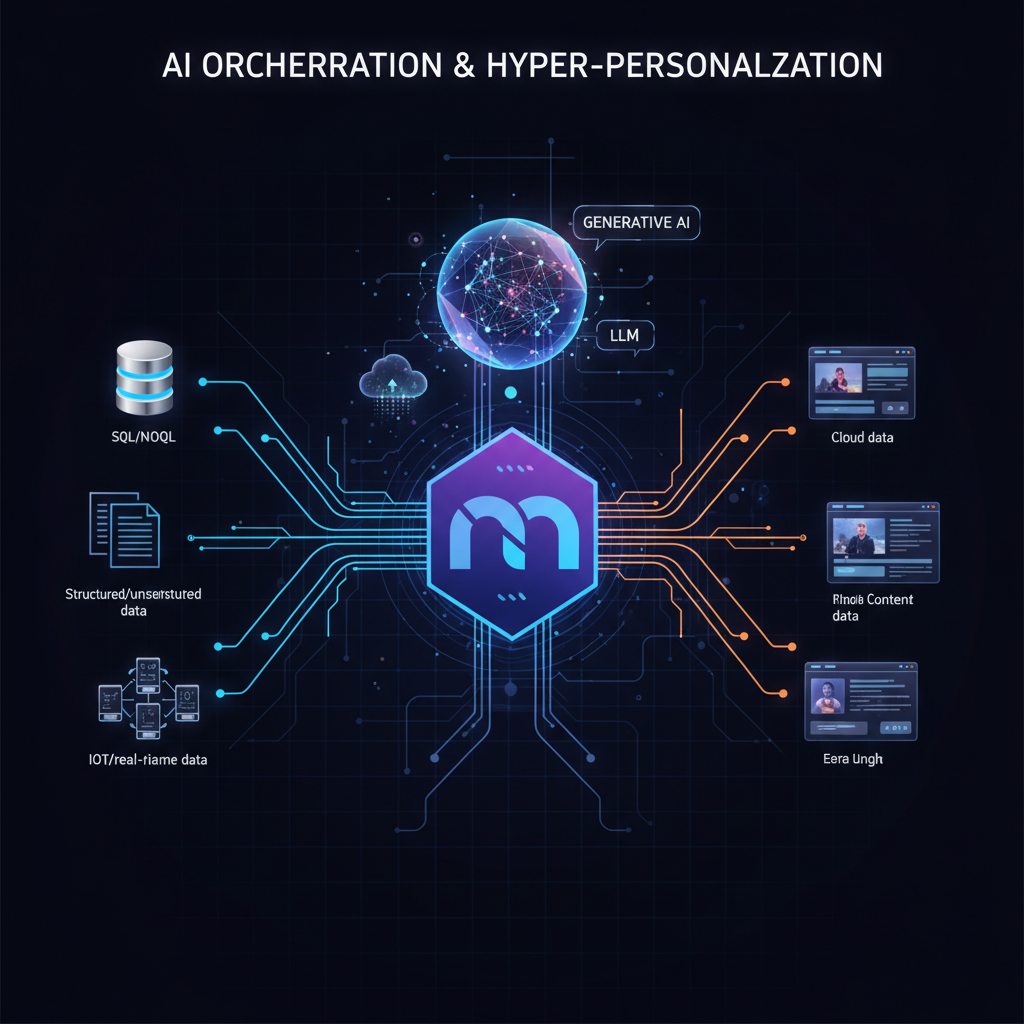
Hyper-Personalization with AI: Orchestrating LLMs and Data with Low-Code Automation
Discover how the rise of hyper-personalization, powered by advanced AI and Large Language Models, is transforming digital content. Learn how low-code automation platforms like n8n connect AI's generative power with diverse data sources for practical, personalized workflows.
The landscape of digital content is undergoing a profound transformation. What was once a world of one-size-fits-all messaging is rapidly evolving into an era of hyper-personalization, driven by the explosive growth of artificial intelligence. From tailored product recommendations to bespoke email campaigns, consumers and businesses alike now expect experiences that feel uniquely crafted for them.
This demand for personalization, coupled with the unprecedented capabilities of Large Language Models (LLMs) like GPT-4o, Claude 3, and Llama 3, alongside powerful image generation models, has created an exciting challenge: how do we efficiently connect these intelligent systems with the myriad data sources and distribution channels that power modern operations? This is precisely where low-code automation platforms like n8n shine, acting as the orchestrator that brings AI's generative power to life in practical, personalized workflows.
The Dawn of Hyper-Personalized AI Workflows
The journey from generic content to hyper-personalized experiences isn't just about having powerful AI models; it's about integrating them seamlessly into your operational fabric. Imagine a world where every customer interaction, every marketing message, and every internal communication is not only relevant but feels as if it were written or designed specifically for the recipient. This isn't a futuristic dream; it's an achievable reality with the right tools and strategies.
n8n, with its robust integration capabilities and growing AI ecosystem, is emerging as a pivotal platform for building these intelligent, automated content pipelines. It empowers both AI practitioners and enthusiasts to move beyond mere experimentation, operationalizing AI models to generate, refine, and distribute content at scale, all while maintaining a high degree of personalization.
n8n's Evolving AI Ecosystem: Building Blocks for Intelligence
n8n has been at the forefront of integrating AI capabilities, continually expanding its suite of nodes and features to support complex AI workflows. These developments are crucial for anyone looking to leverage AI effectively.
Dedicated AI Nodes: Your Gateway to Generative Power
The foundation of any AI workflow in n8n lies in its dedicated AI nodes. These pre-built integrations provide direct access to the most popular and powerful AI services:
- OpenAI Node: This is a powerhouse, offering direct access to models like GPT-4o for advanced text generation, summarization, translation, and more. It also supports the Assistants API, enabling complex multi-turn conversations and tool use, and DALL-E for image generation.
- Google AI Node: Integrates with Google's Gemini models, providing another robust option for multimodal understanding and generation.
- Hugging Face Node: For those who prefer open-source models or need specialized tasks, the Hugging Face node allows interaction with a vast array of models hosted on the Hugging Face Hub, from text classification to sentiment analysis.
- Custom HTTP Requests: For niche models, self-hosted solutions, or specific API endpoints not covered by dedicated nodes, the HTTP Request node offers ultimate flexibility, allowing you to connect to virtually any AI service with a REST API.
These nodes act as the "brains" of your workflow, taking input data and returning AI-generated content or insights.
The AI Agent Framework: Orchestrating Intelligence
A significant recent development in n8n is its evolving AI Agent framework. This isn't just about calling an LLM once; it's about enabling multi-step reasoning, dynamic adaptation, and tool use within a single workflow.
An n8n AI Agent can:
- Understand a Goal: Given a prompt, the agent comprehends the overall objective (e.g., "Generate a personalized email campaign for new sign-ups").
- Plan Steps: It breaks down the goal into smaller, manageable tasks (e.g., "Fetch user data," "Generate email body," "Generate subject line," "Send email").
- Utilize Tools: The agent can then "use" other n8n nodes as tools. For example, it might use a "CRM" node to fetch user data, an "OpenAI" node to generate text, and an "Email" node to send the message.
- Iterate and Adapt: If an initial attempt fails or requires more information, the agent can loop back, refine its approach, or request additional data, mimicking human problem-solving.
This framework allows for the creation of far more sophisticated and autonomous workflows, moving beyond simple input-output operations to intelligent decision-making within your automation.
Vector Database Integrations: Grounding AI in Reality (RAG)
For truly personalized and accurate content, AI models need access to specific, up-to-date, or proprietary information. This is where Retrieval Augmented Generation (RAG) comes into play, and n8n's integrations with vector databases are crucial.
Vector databases (like Pinecone, Weaviate, Qdrant, Chroma, Milvus) store information as numerical embeddings, allowing for semantic search – finding content based on meaning, not just keywords.
How n8n leverages RAG:
- Ingestion: n8n can monitor data sources (e.g., internal documents, product catalogs, customer support tickets), process them (e.g., chunking text, generating embeddings via an embedding model), and then store these embeddings in a vector database.
- Retrieval: When an AI model needs to generate content, n8n first queries the vector database with the user's request or context. The database returns the most semantically relevant pieces of information.
- Augmentation: This retrieved information is then provided to the LLM as part of its prompt, grounding the AI's response in factual, relevant data.
This process ensures that the AI-generated content is not only creative but also accurate, relevant, and consistent with your specific knowledge base, preventing "hallucinations" and enhancing personalization.
Conditional Logic & Human-in-the-Loop: Ensuring Quality and Control
While AI is powerful, human oversight remains critical. n8n excels at building workflows that incorporate conditional logic and human-in-the-loop processes.
- Quality Gates: You can set up conditions to evaluate AI output. For example, "If the sentiment of the generated email is negative," or "If the generated text contains specific keywords," then trigger a human review.
- Approval Workflows: AI-generated content can be routed to a specific team member or manager for approval before distribution. This can involve sending a message to Slack, creating a task in a project management tool, or sending an email with the content for review.
- Dynamic Branching: Based on AI analysis (e.g., "Is this customer a high-value lead?"), the workflow can dynamically choose different paths, leading to different content, channels, or follow-up actions.
These features ensure that even highly automated AI workflows maintain quality, compliance, and brand consistency.
Emerging Trends: The Future of AI-Driven Content
The capabilities of n8n in orchestrating AI are paving the way for several exciting trends:
- Dynamic Content Personalization: Moving beyond simple merge tags, AI can now generate entire content pieces (text, images, video scripts) that are truly unique to each individual, based on their real-time behavior, past interactions, and inferred preferences.
- Multi-Modal Content Generation: Workflows can now combine text generation (LLMs) with image generation (DALL-E, Stable Diffusion), and even audio/video script generation, creating rich, immersive content experiences from a single input.
- Autonomous Marketing & Sales Workflows: The vision of AI agents interacting with CRMs, crafting personalized outreach, scheduling meetings, and drafting follow-up sequences with minimal human intervention is becoming a reality.
- "AI as a Service" Orchestration: n8n allows you to chain together multiple specialized AI models. For instance, one model for summarization, another for tone adjustment, a third for translation, and a fourth for content classification, all orchestrated into a cohesive pipeline.
Practical Applications & Use Cases: Bringing AI to Life
Let's explore how these concepts translate into tangible, high-value applications across various domains.
1. Personalized Email Marketing Campaigns
Scenario: A SaaS company wants to send highly personalized onboarding emails to new users based on their sign-up data, in-app behavior, and stated interests.
n8n Workflow:
- Trigger: A new user signs up in the SaaS platform (webhook from the platform or scheduled check of a database).
- Fetch User Data: Retrieve detailed user profile from CRM (e.g., HubSpot, Salesforce) or internal database, including industry, role, and initial product selections.
- Retrieve Relevant Content (RAG):
- Query a vector database (e.g., Pinecone) containing product documentation, use-case examples, and blog posts.
- The query uses the user's industry and initial product selections to find the most relevant articles or features.
- Generate Personalized Email Content (OpenAI):
- Send the user data and retrieved content to an OpenAI node (e.g., GPT-4o).
- Prompt Example: "You are an expert SaaS onboarding specialist. Write a warm, encouraging onboarding email to [User Name] from [User Company] who just signed up for [Product Name]. Their industry is [User Industry] and they are interested in [User Interests]. Based on the following relevant product information: [Retrieved Content], highlight 2-3 key features most relevant to their profile and suggest a next step. Include a personalized subject line. Maintain a helpful and professional tone."
- The LLM generates the subject line and email body.
- Generate Personalized Image (DALL-E):
- Based on the user's industry or stated interest, use the DALL-E model via the OpenAI node to generate a relevant hero image for the email (e.g., "An illustration of a [User Industry] professional using [Product Name] in a modern office setting").
- Send Email: Use a SendGrid, Mailchimp, or custom SMTP node to send the personalized email.
- Update CRM: Log the sent email content and status back into the user's CRM record for future reference and analytics.
This workflow ensures each new user receives an email that feels genuinely tailored, increasing engagement and reducing churn.
2. Automated Social Media Content Creation & Scheduling
Scenario: A content marketing team wants to automatically generate diverse social media posts across multiple platforms based on newly published blog articles, ensuring brand consistency and engagement.
n8n Workflow:
- Trigger: New blog post published (RSS feed node or webhook from CMS like WordPress/Webflow).
- Extract Content: Fetch the full blog post content.
- Summarize & Extract Keywords (OpenAI):
- Send the blog post to an OpenAI node to summarize it into a few key points.
- Extract relevant keywords and hashtags.
- Generate Multi-Platform Captions (OpenAI):
- Using the summary and keywords, prompt the LLM to generate multiple captions tailored for different platforms:
- LinkedIn: Professional, thought-provoking, includes a question.
- Twitter/X: Concise, engaging, includes relevant hashtags.
- Instagram: Visually descriptive, includes emojis, calls to action.
- Using the summary and keywords, prompt the LLM to generate multiple captions tailored for different platforms:
- Generate Visuals (DALL-E/Stable Diffusion):
- Based on the blog post's topic, use an image generation model to create 2-3 unique images or illustrations suitable for social media.
- Schedule Posts:
- Use Buffer, Hootsuite, or direct API integrations for LinkedIn, Twitter, Instagram, and Facebook.
- Schedule each platform's unique caption and image.
- Notification: Send a Slack or email notification to the marketing team with a summary of scheduled posts.
This workflow drastically reduces the manual effort of social media management while ensuring fresh, relevant, and platform-optimized content.
3. Dynamic Product Descriptions & SEO Content for E-commerce
Scenario: An e-commerce business needs to generate unique, SEO-friendly product descriptions and meta-content for hundreds of new products quickly.
n8n Workflow:
- Trigger: New product added to Shopify/WooCommerce (webhook or scheduled check).
- Fetch Product Data: Retrieve product name, SKU, features, specifications, and existing short descriptions.
- Generate SEO-Optimized Content (OpenAI):
- Send the product data to an OpenAI node.
- Prompt Example: "You are an e-commerce SEO specialist. Generate a unique, engaging, and SEO-optimized long description (200-300 words), a short description (50 words), a meta title (60 chars), and a meta description (160 chars) for the following product: [Product Name]. Features: [List of Features]. Target keywords: [Keywords]. Focus on benefits and unique selling points."
- The LLM generates all required content.
- Generate Product Image Variations (DALL-E/Stable Diffusion):
- Based on the product name and description, generate alternative lifestyle images or different angles of the product.
- Update E-commerce Platform: Use the Shopify/WooCommerce node to update the product with the newly generated long description, short description, meta title, meta description, and additional images.
- Review & Approval (Optional): Route the generated content for human review before final publication, especially for high-value products.
This automates a labor-intensive process, ensuring consistent, high-quality, and SEO-friendly product content across the entire catalog.
4. Internal Knowledge Base Augmentation & Q&A
Scenario: A company wants to automatically process new internal documents (meeting notes, policy updates) to augment its knowledge base and enable RAG-powered internal Q&A.
n8n Workflow:
- Trigger: New document uploaded to Google Drive, SharePoint, or Notion (webhook or scheduled check).
- Extract Text: Read the content of the document.
- Summarize & Extract Key Points (OpenAI):
- Use an LLM to summarize the document, identify key decisions, action items, and categorize its content.
- Generate Embeddings: Send the processed text (or chunks of it) to an embedding model (e.g., via OpenAI or Hugging Face) to generate vector embeddings.
- Store in Vector Database: Store the text content and its corresponding embeddings in a vector database (e.g., Chroma, Weaviate).
- Update Knowledge Base/Notify Teams:
- Optionally, push a summary or link to the processed document to an internal knowledge base (e.g., Confluence).
- Send a Slack or email notification to relevant teams about the new content.
This workflow ensures that internal knowledge is continuously updated and made searchable via semantic search, enabling employees to get instant answers to questions grounded in the company's proprietary data.
Value for AI Practitioners and Enthusiasts
For those deeply involved in AI, n8n offers immense value:
- Deployment & Operationalization: It provides a practical, low-code framework to take AI models from experimental prototypes to production-ready solutions, integrating them into real-world business processes.
- Rapid Prototyping: Quickly build, test, and iterate on complex AI workflows without writing extensive custom code, accelerating the development cycle.
- Bridging the Gap: Connect powerful, often isolated, AI models with existing business systems (CRMs, marketing automation platforms, databases) that may lack native AI integration.
- Focus on Logic, Not Infrastructure: AI practitioners can dedicate their time to refining model performance, prompt engineering, and data quality, while n8n handles the orchestration, scheduling, API interactions, and error handling.
- Democratization of AI: By visually representing complex AI pipelines, n8n makes sophisticated AI capabilities accessible to a broader audience, including non-developers, fostering cross-functional collaboration.
Conclusion
The synergy between n8n and advanced AI models marks a significant leap forward in how organizations can create, personalize, and distribute content. By providing a flexible, low-code platform for orchestrating AI, n8n empowers businesses to move beyond generic communication to deliver hyper-personalized experiences at scale.
From dynamic email campaigns and automated social media to intelligent knowledge management, the possibilities are vast. As AI models continue to evolve and n8n further refines its AI agent capabilities and integrations, we can expect even more sophisticated, autonomous, and impactful workflows to emerge. The future of content is personalized, and n8n is proving to be an indispensable tool in building that future, making advanced AI accessible and actionable for everyone.