Unlocking IoT's Potential: The Power of Federated Learning & Edge Computing
Explore how the convergence of Federated Learning and Edge Computing is revolutionizing AI in the IoT era. Discover how these technologies address privacy, bandwidth, and computational challenges, safeguarding sensitive data while maximizing intelligence from billions of connected devices.
The digital landscape is undergoing a profound transformation, driven by the proliferation of interconnected devices that form the Internet of Things (IoT). From smart homes to industrial complexes, billions of sensors, actuators, and smart gadgets are generating an unprecedented deluge of data. This data holds immense potential for intelligence and automation, yet it also presents significant challenges related to privacy, network bandwidth, and computational resources. Traditional cloud-centric AI models struggle to cope with these demands, leading to a critical need for more distributed and privacy-aware approaches. This is where the powerful synergy of Federated Learning (FL) and Edge Computing emerges as a game-changer, promising to unlock the full potential of AI in the IoT era while safeguarding sensitive information.
The Foundation: IoT, Edge, and Federated Learning Explained
To appreciate the power of this convergence, let's first understand its core components:
-
Internet of Things (IoT): Imagine a world where everyday objects are imbued with digital intelligence. This is the IoT – a vast network of physical devices, vehicles, home appliances, and other items embedded with sensors, software, and network connectivity, allowing them to collect and exchange data. Examples range from smart thermostats adjusting your home's temperature to industrial sensors monitoring machinery health, and even wearable fitness trackers. The defining characteristic is their ability to generate real-time data from the physical world.
-
Edge Computing: Historically, data generated by devices would be sent to a centralized cloud server for processing and analysis. Edge computing flips this paradigm by bringing computation and data storage closer to the source of data generation – the "edge" of the network. This could be a local gateway, a powerful router, or even the IoT device itself. By processing data locally, edge computing drastically reduces latency, conserves bandwidth, and enhances real-time responsiveness, which is crucial for applications like autonomous vehicles or critical infrastructure monitoring.
-
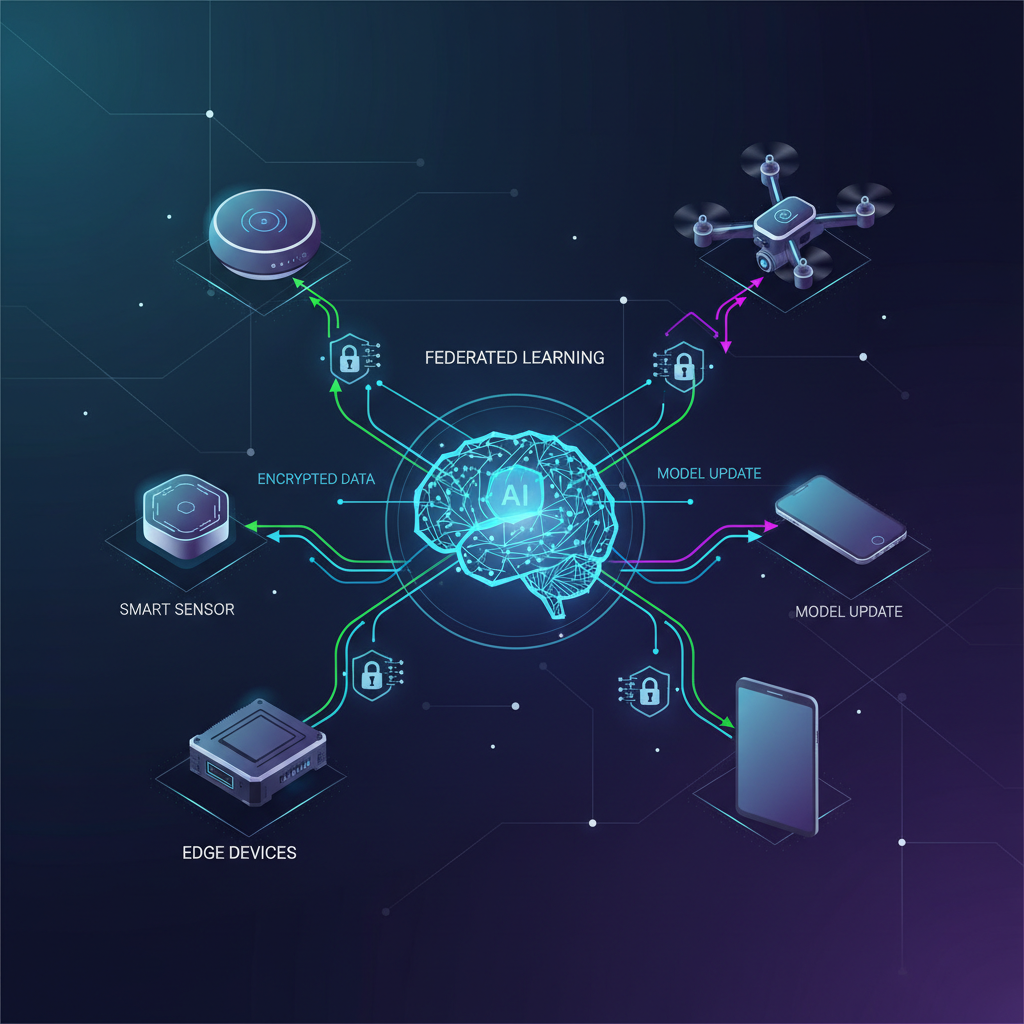
Federated Learning (FL): This is a distributed machine learning approach that enables multiple entities (clients) to collaboratively train a shared global model without ever exchanging their raw, local data. Instead of sending sensitive data to a central server, each client trains a local model on its private dataset. Only the model updates (e.g., changes in weights or gradients) are sent to a central server. The server then aggregates these updates to improve the global model, which is subsequently sent back to the clients for further local refinement. This iterative process allows for continuous learning while preserving data privacy.
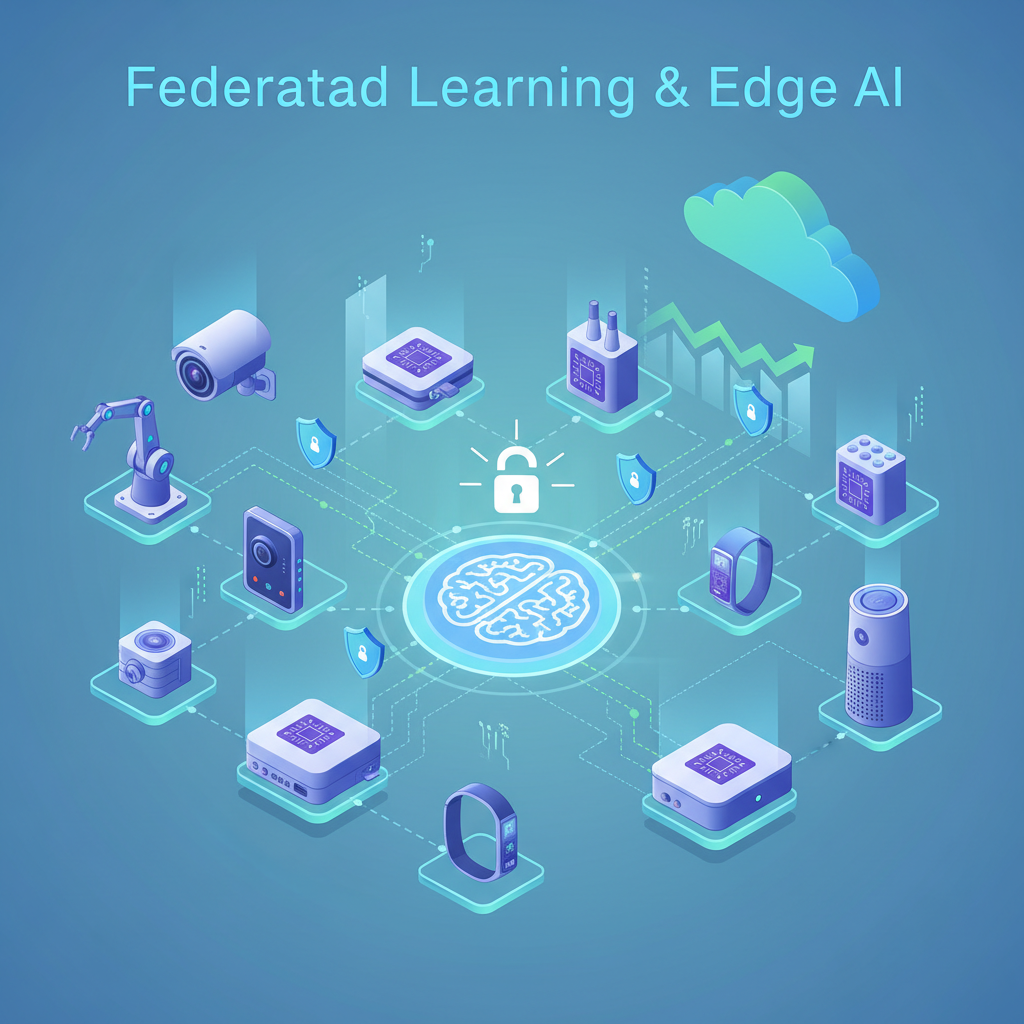
Bringing it all together: Federated Learning at the Edge for IoT When we combine these concepts, "Federated Learning at the Edge for IoT" means that AI model training occurs directly on or very near the IoT devices. These devices, or their immediate edge gateways, locally train an AI model using their own generated data. Crucially, they do not transmit this raw data. Instead, they send only the learned parameters (the "knowledge" derived from the data) to a central aggregator. This aggregator, which could be a powerful edge server or a cloud instance, combines these updates to create a more robust global model. This improved model is then distributed back to the devices, allowing them to benefit from the collective intelligence without compromising their individual data.
Why Now? The Timeliness and Impact
The confluence of these technologies is not merely a theoretical exercise; it's a practical necessity driven by several pressing factors:
-
Explosive Growth of IoT Data: The sheer volume and velocity of data generated by billions of IoT devices are overwhelming traditional cloud infrastructure. Transmitting, storing, and processing all this data centrally is becoming economically and technically unsustainable due to bandwidth limitations and storage costs. FL at the edge offers a scalable solution by processing data where it originates.
-
Mounting Privacy and Regulatory Concerns: With regulations like GDPR, CCPA, and others, data privacy is paramount. Many IoT applications, particularly in healthcare, smart homes, and personal wearables, handle highly sensitive information. Federated Learning provides a robust privacy-preserving mechanism, as raw data never leaves the device, directly addressing these concerns.
-
Demand for Real-time AI and Low Latency: Applications like autonomous systems, industrial automation, and critical infrastructure monitoring require immediate AI inferences. Edge AI inherently provides low latency, and FL ensures that these edge models can continuously learn and adapt without constant, high-latency interactions with the cloud.
-
Resource Constraints of IoT Devices: Many IoT devices are resource-constrained, with limited computational power, memory, and battery life. While full-scale training on tiny devices might be challenging, FL paradigms are evolving to accommodate these constraints through techniques like model quantization, pruning, and efficient aggregation algorithms, enabling "TinyML" integration.
-
Heterogeneity of IoT Data: Data from different IoT devices or users can vary significantly in distribution (non-IID data). FL can adapt to this by allowing local models to learn specific patterns relevant to their context while still contributing to a more generalized, robust global model.
-
Industry Momentum and Emerging Frameworks: Major tech giants like Google (TensorFlow Federated), NVIDIA, Intel, and Qualcomm are heavily investing in FL and edge AI. This investment is leading to the development of specialized hardware accelerators and user-friendly software frameworks, accelerating adoption and innovation.
Recent Developments and Emerging Trends
The field of Federated Learning at the Edge for IoT is dynamic, with continuous advancements addressing its inherent complexities:
-
Personalization within FL: Beyond a single, one-size-fits-all global model, research is exploring personalized FL. This allows each device to retain a slightly customized model that caters to its unique data distribution or user behavior, while still benefiting from the collective knowledge of the global model. For instance, a smart home thermostat might learn your specific heating preferences while also benefiting from general energy-saving patterns learned across a neighborhood.
-
Communication Efficiency: The bottleneck in FL is often the communication overhead between edge devices and the central server. Innovations in this area include:
- Sparsification: Sending only the most significant model updates.
- Quantization: Reducing the precision of model parameters to decrease message size.
- Asynchronous FL: Allowing devices to send updates at their own pace, rather than waiting for a synchronized round, which is crucial for intermittently connected IoT devices.
-
Security and Trust in FL: While FL offers privacy benefits, it's not immune to security threats. Research is actively addressing:
- Poisoning Attacks: Malicious devices sending corrupted updates to degrade the global model.
- Inference Attacks: Attempts to reconstruct sensitive training data from shared model updates.
- Solutions involve Secure Aggregation (using cryptographic techniques like homomorphic encryption to aggregate updates without decrypting individual contributions), Differential Privacy (adding noise to updates to obscure individual contributions), and robust anomaly detection for malicious clients.
-
Hardware Acceleration for Edge FL: To enable faster local training and inference on resource-constrained devices, specialized AI accelerators like Neural Processing Units (NPUs), Tensor Processing Units (TPUs), and optimized GPUs are being integrated into edge devices and gateways.
-
Integration with TinyML: Extending FL concepts to extremely resource-constrained microcontrollers (TinyML) is pushing the boundaries of on-device learning for ultra-low-power applications, enabling intelligence in even the smallest IoT sensors.
-
Vertical-Specific Applications: FL at the edge is finding traction across various industries:
- Smart Cities: Collaborative learning among traffic sensors to predict congestion, optimize traffic light timings, or identify anomalies in public infrastructure.
- Healthcare: Wearable devices collectively train models for early disease detection, personalized health recommendations, or remote patient monitoring, all without sharing sensitive patient health records.
- Industrial IoT (IIoT): Machines on a factory floor can collaboratively learn predictive maintenance models, identifying potential equipment failures before they occur, improving quality control, and optimizing operational efficiency, while keeping proprietary operational data within the factory's perimeter.
- Autonomous Systems: Fleets of self-driving cars, drones, or robots can collaboratively improve their perception, navigation, and decision-making models. For example, cars can share learned features about road conditions or obstacles without revealing their specific routes or sensor data.
Practical Applications and Value for AI Practitioners/Enthusiasts
For anyone involved in AI, data science, or IoT development, understanding Federated Learning at the Edge is not just academically interesting but practically invaluable:
-
Privacy-Preserving Analytics: This is perhaps the most compelling benefit. Practitioners can develop AI solutions that derive insights from highly sensitive data sources (e.g., medical devices, smart home activity, personal wearables) without ever needing to centralize or expose the raw personal information. This opens up entirely new avenues for data-driven services that were previously impossible due to privacy concerns.
-
Reduced Bandwidth Costs and Energy Consumption: By processing and learning locally, the amount of data transmitted to the cloud is drastically reduced. This translates to significant cost savings on bandwidth, especially in environments with limited or expensive connectivity. It also reduces energy consumption for data transmission, extending the battery life of remote IoT devices.
-
Lower Latency AI for Real-time Decisions: Models are trained and updated closer to the data source, enabling near real-time inference. This is critical for applications where milliseconds matter, such as anomaly detection in industrial control systems, immediate response in autonomous vehicles, or instant alerts from health monitors.
-
Robustness to Network Outages: Local model training and inference can continue even if connectivity to the central server is intermittent or temporarily lost. Devices can operate autonomously with their latest local model, uploading updates when connectivity is restored, enhancing system resilience.
-
Continuous Learning and Adaptation: IoT devices can continuously learn from new data generated in their unique environments. This allows models to adapt to changing conditions, user behaviors, or evolving patterns without requiring frequent, full model re-deployments from the cloud, leading to more dynamic and accurate AI.
-
New Business Models and Data Monetization: FL enables innovative business models where insights derived from proprietary data can be shared or monetized, while the raw, sensitive data remains securely on the client devices. This fosters collaboration and value creation without compromising data ownership or privacy.
-
Abundant Research and Development Opportunities: This field is ripe with challenges and opportunities for innovation. Practitioners can contribute to developing more robust algorithms for non-IID data, enhancing security protocols, optimizing communication efficiency, designing scalable system architectures, and creating new evaluation benchmarks for real-world IoT scenarios.
Navigating the Challenges Ahead
While the promise of Federated Learning at the Edge is immense, several challenges need to be addressed for widespread adoption:
-
Statistical Heterogeneity (Non-IID Data): The data distribution across different IoT devices can vary significantly. This "non-IID" (non-independent and identically distributed) nature can make it difficult for a global model to converge effectively or perform optimally across all clients. Research into personalized FL and robust aggregation algorithms is crucial here.
-
System Heterogeneity: IoT devices are incredibly diverse in their computational power, memory, battery life, and network connectivity. Designing FL systems that can accommodate this wide spectrum of capabilities is a complex engineering challenge.
-
Security and Trust: Despite its privacy benefits, FL introduces new attack vectors. Ensuring the integrity of the aggregated model against malicious clients and protecting against potential data reconstruction from shared updates requires sophisticated cryptographic and adversarial learning techniques.
-
Deployment and Management: Orchestrating FL training across a vast number of diverse, often geographically dispersed, and intermittently connected IoT devices presents significant challenges in terms of system design, deployment, monitoring, and debugging.
-
Evaluation and Benchmarking: Establishing standardized methods to evaluate the performance, privacy guarantees, and communication efficiency of FL systems in real-world IoT scenarios is essential for comparing different approaches and driving progress.
Conclusion
Federated Learning at the Edge for IoT is not merely a technological trend; it is a fundamental shift in how we conceive and deploy artificial intelligence in the connected world. It's a practical necessity driven by the insatiable demand for data privacy, the constraints of network bandwidth, and the imperative for real-time, intelligent decision-making in an ever-expanding ecosystem of IoT devices.
For AI practitioners and enthusiasts, this domain offers a fertile ground for innovation. From developing novel algorithms that handle data heterogeneity and resource constraints to engineering secure and scalable distributed systems, the opportunities are boundless. By embracing and contributing to this field, we can unlock the true potential of AI in IoT, creating a future where intelligence is ubiquitous, efficient, and, most importantly, privacy-preserving. The journey to truly intelligent, privacy-aware IoT solutions is underway, and Federated Learning at the Edge is leading the charge.