Autonomous AI Agents for Software Development: The Next Frontier
Explore the revolutionary shift towards autonomous AI agents in software development. This new paradigm moves beyond code generation, enabling AI to understand requirements, plan, test, and deploy solutions, fundamentally redefining human roles and accelerating innovation.
The landscape of artificial intelligence is constantly shifting, pushing the boundaries of what machines can achieve. While large language models (LLMs) have revolutionized our ability to generate text, images, and even code snippets, a new paradigm is emerging that promises to transform one of the most complex human endeavors: software development. We're moving beyond simple code generation to the era of Autonomous AI Agents for Software Development, capable of not just writing code, but understanding requirements, planning, testing, self-correcting, and even deploying solutions.
This isn't just an incremental improvement; it's a fundamental shift towards AI-driven development workflows, promising to accelerate innovation, improve software quality, and fundamentally redefine the role of human developers.
The Evolution: From Code Completion to Autonomous Engineering
To appreciate the significance of autonomous AI agents, it's helpful to trace the evolution of AI in software development:
- Code Completion & Suggestion (e.g., IntelliSense, early Copilot): These tools offer real-time suggestions for variables, functions, and syntax, significantly speeding up typing and reducing errors. They act as intelligent auto-completion.
- Code Generation (e.g., GitHub Copilot, Tabnine): LLMs trained on vast code repositories can generate entire functions, classes, or even small scripts based on natural language prompts or surrounding code context. This is a powerful productivity booster, offloading boilerplate and common patterns.
- Code Transformation & Refactoring (e.g., AI-powered refactoring tools): These tools can analyze existing code and suggest improvements, convert between languages, or update deprecated syntax.
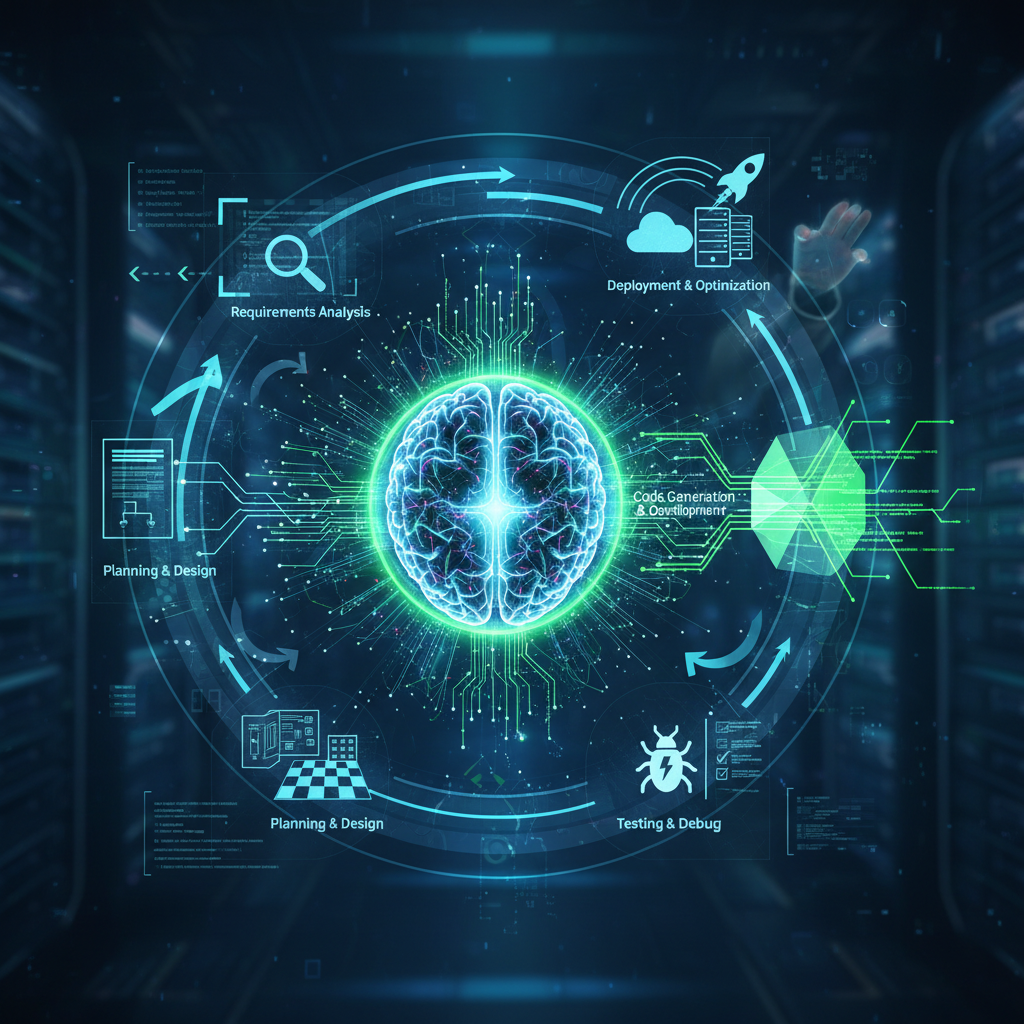
- Autonomous AI Agents (e.g., Devin, AlphaCode 2, AutoGen-based systems): This is the frontier. These agents are designed to act with a higher degree of autonomy, mimicking the end-to-end thought process of a human software engineer. They can:
- Understand complex, high-level requirements.
- Decompose tasks into smaller, manageable sub-problems.
- Plan a sequence of actions.
- Generate code.
- Execute code and run tests.
- Identify errors and debug.
- Self-correct and iterate on their solutions.
- Interact with external tools (IDEs, compilers, version control, CI/CD).
- Potentially deploy the final product.
This leap from assistive tools to autonomous agents marks a pivotal moment, transforming AI from a co-pilot into a potential co-engineer.
The Architecture of an Autonomous AI Agent
Building an autonomous AI agent for software development requires more than just a powerful LLM. It necessitates a sophisticated architecture that integrates several key components:
1. The Core LLM: The Brain
At the heart of every agent is a powerful Large Language Model (LLM) like GPT-4, Claude, or Llama. This LLM acts as the agent's "brain," responsible for:
- Understanding: Interpreting natural language requirements, error messages, and documentation.
- Reasoning & Planning: Devising strategies, breaking down problems, and generating action plans.
- Code Generation: Producing syntactically correct and semantically meaningful code.
- Self-Reflection: Analyzing its own output, identifying shortcomings, and formulating corrective actions.
2. Memory: Context and Learning
Autonomous agents need memory to maintain context across multiple interactions and learn from past experiences:
- Short-Term Memory (Context Window): The immediate context provided to the LLM for a given turn, including current task, recent interactions, and relevant code snippets.
- Long-Term Memory (Vector Databases, Knowledge Bases): For storing past solutions, common patterns, project-specific documentation, API specifications, and even successful debugging strategies. This allows agents to learn and improve over time, avoiding repetitive mistakes.
3. Tool Use: Interacting with the World
A crucial component is the ability to use external tools, transforming the LLM from a text generator into an actor in the software development environment. These tools can include:
- Code Interpreters/Executors: Running generated code (e.g., Python interpreter, Node.js runtime).
- Testing Frameworks: Executing unit tests, integration tests (e.g., pytest, JUnit).
- Debuggers: Analyzing runtime errors and stack traces.
- Version Control Systems (VCS): Interacting with Git to clone repositories, commit changes, create branches, and merge.
- IDEs/Editors: Reading and writing files, navigating project structures.
- Documentation Search: Accessing API docs, Stack Overflow, etc.
- CI/CD Pipelines: Triggering builds, deployments.
- Web Browsers: For research and gathering information.
The agent decides which tool to use based on its current goal and the output of its LLM.
4. Planning & Task Decomposition: Breaking Down Complexity
Given a high-level requirement, the agent must be able to:
- Decompose: Break it down into a series of smaller, actionable sub-tasks.
- Plan: Order these sub-tasks logically, considering dependencies.
- Monitor: Track progress against the plan and adjust as needed.
This often involves techniques like Chain-of-Thought (CoT) prompting or more sophisticated planning algorithms that allow the LLM to "think step-by-step."
5. Self-Correction & Iteration: The Debugging Loop
This is perhaps the most critical differentiator from simple code generation. An autonomous agent can:
- Execute Code: Run the generated code.
- Evaluate Output: Analyze the results, including test failures, error messages, or unexpected behavior.
- Diagnose: Use its LLM to understand why something went wrong.
- Formulate Fixes: Generate new code or modify existing code to address the issue.
- Re-test: Repeat the process until the desired outcome is achieved.
This iterative feedback loop is what gives these agents their "autonomous" capability, allowing them to troubleshoot and refine solutions without constant human intervention.
Practical Examples and Use Cases
The implications of autonomous AI agents for software development are vast and varied:
1. Feature Development from Scratch
Imagine providing an agent with a user story: "As a user, I want to be able to upload a profile picture to my account." The agent could:
- Plan: Identify steps like creating an API endpoint, handling file uploads, storing the image, updating the user profile in the database, and adding a UI component.
- Generate Code: Write backend code (e.g., Python/Flask, Node.js/Express) for the endpoint, database schema modifications, and frontend code (e.g., React, Vue) for the upload component.
- Test: Generate and run unit and integration tests for the new functionality.
- Debug: If a test fails (e.g., file size limit exceeded), it identifies the error, modifies the code, and re-tests.
- Deploy: Potentially push changes to a staging environment for human review.
2. Bug Fixing and Troubleshooting
An agent could be fed a bug report and a stack trace:
- Analyze: Read the bug report and the error logs.
- Localize: Pinpoint the likely source of the error in the codebase.
- Propose Fixes: Generate potential code changes.
- Test: Apply the fix, run relevant tests (or generate new ones), and verify the bug is resolved.
- Submit: Create a pull request with the fix and test results.
3. Refactoring and Technical Debt Reduction
- Identify Code Smells: Agents could analyze a codebase for common anti-patterns or areas that violate best practices.
- Suggest & Implement Refactors: Propose changes to improve readability, performance, or maintainability (e.g., extracting a function, simplifying a conditional).
- Automate Migrations: Update codebases to new library versions or language features.
4. Code Review and Quality Assurance
While not fully autonomous development, agents can augment code review by:
- Identifying Potential Bugs: Flagging common error patterns.
- Suggesting Improvements: Proposing more idiomatic code or performance optimizations.
- Ensuring Compliance: Checking against coding standards or security best practices.
5. Prototyping and Experimentation
Rapidly generate proof-of-concept applications or test out different architectural approaches without significant human effort. This lowers the cost of experimentation.
Key Research and Development Areas
The field is nascent, and several challenges and opportunities remain:
- Robust Planning and Task Decomposition: How do agents handle ambiguity in requirements? How do they learn optimal strategies for complex, multi-step tasks? Hierarchical planning and reinforcement learning are active research areas.
- Effective Tool Integration and Orchestration: Seamlessly integrating with a diverse set of developer tools and knowing when and how to use each one effectively is crucial. This involves robust API interaction and error handling.
- Advanced Self-Correction and Debugging: Moving beyond simple test failures to diagnose complex logical errors, performance bottlenecks, or security vulnerabilities requires deeper reasoning capabilities.
- Memory Management and Context Persistence: How do agents maintain a consistent understanding of a large codebase and project state over extended periods? Efficiently retrieving relevant information from long-term memory is key.
- Human-Agent Collaboration and Control: Defining optimal interfaces for humans to supervise, guide, and intervene when agents get stuck or go off track. How do we ensure transparency and interpretability of agent actions?
- Evaluation Metrics and Benchmarking: Developing standardized ways to measure the performance, reliability, safety, and efficiency of autonomous coding agents across various tasks and domains.
- Ethical Considerations: Addressing issues of code ownership, intellectual property, security vulnerabilities introduced by AI-generated code, and the impact on human developer roles.
The Future of Software Development: Human-Agent Synergy
It's unlikely that autonomous AI agents will completely replace human software engineers in the near future. Instead, they are poised to usher in an era of unprecedented human-agent synergy. Developers will evolve from being primary code writers to becoming architects, strategists, reviewers, and supervisors of AI agents.
Imagine a future where:
- A developer outlines a high-level feature.
- An AI agent generates the initial codebase, sets up tests, and proposes a deployment strategy.
- The human developer reviews the agent's work, provides high-level guidance, and focuses on complex architectural decisions, creative problem-solving, and ensuring alignment with business goals.
- The agent then iterates on the code, fixes bugs, and handles routine maintenance, freeing up the human to innovate.
This collaborative model promises to significantly amplify human productivity, allowing us to build more complex, robust, and innovative software at an accelerated pace.
Conclusion
The emergence of autonomous AI agents for software development represents one of the most exciting and impactful frontiers in artificial intelligence. By moving beyond simple code generation to encompass planning, execution, self-correction, and deployment, these agents are poised to fundamentally reshape how software is conceived, built, and maintained.
For AI practitioners and enthusiasts, this field offers a rich tapestry of research challenges, practical applications, and ethical considerations. Understanding the underlying architectures, experimenting with emerging frameworks like AutoGen and CrewAI, and contemplating the future of human-AI collaboration in engineering will be crucial for anyone looking to stay at the forefront of this technological revolution. The journey from human-assisted coding to AI-driven development is just beginning, and its destination promises to be transformative.