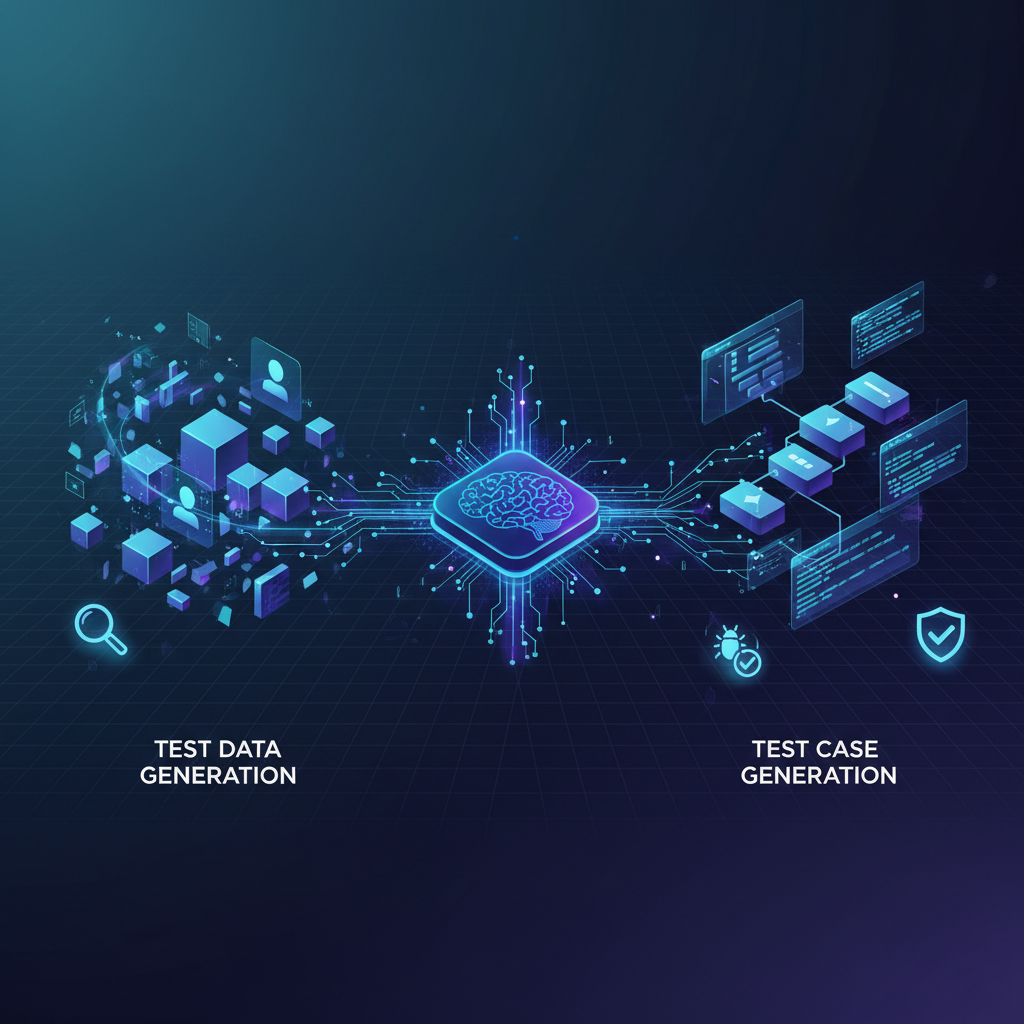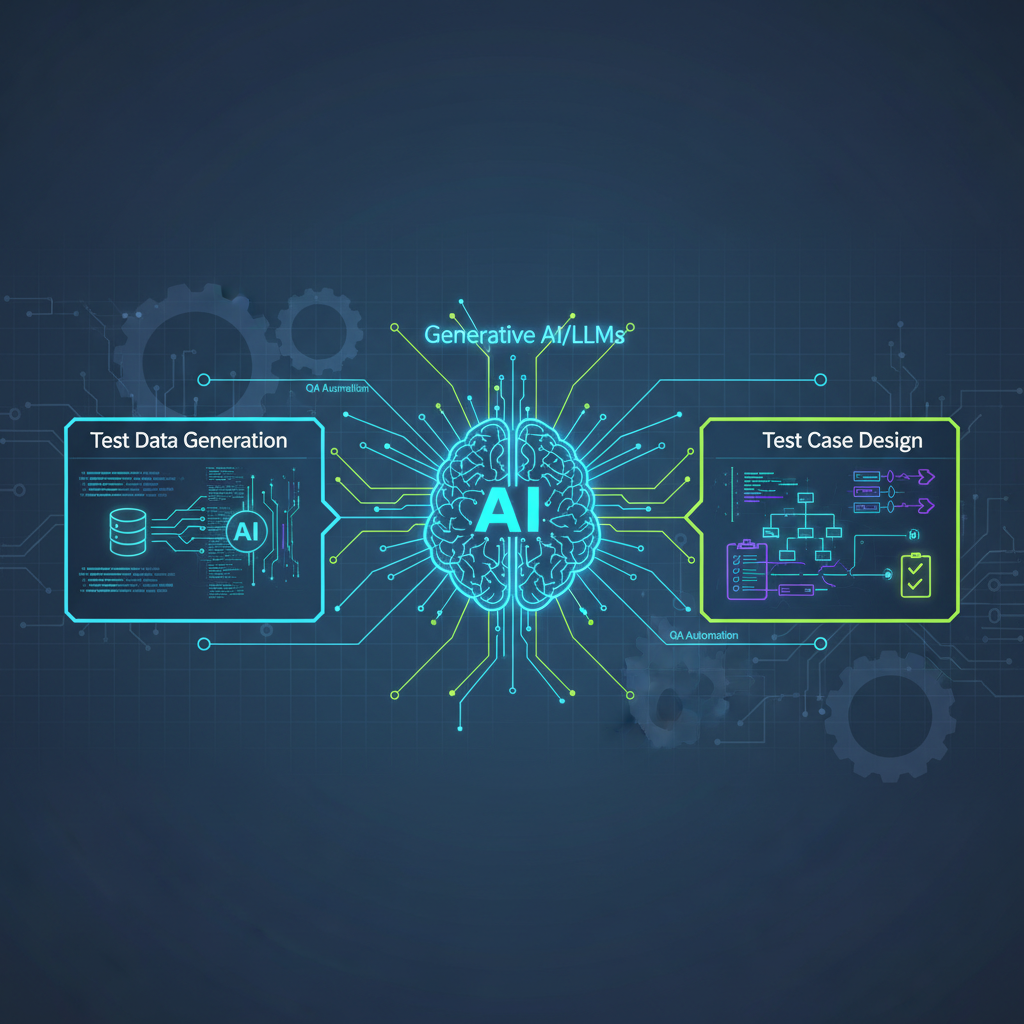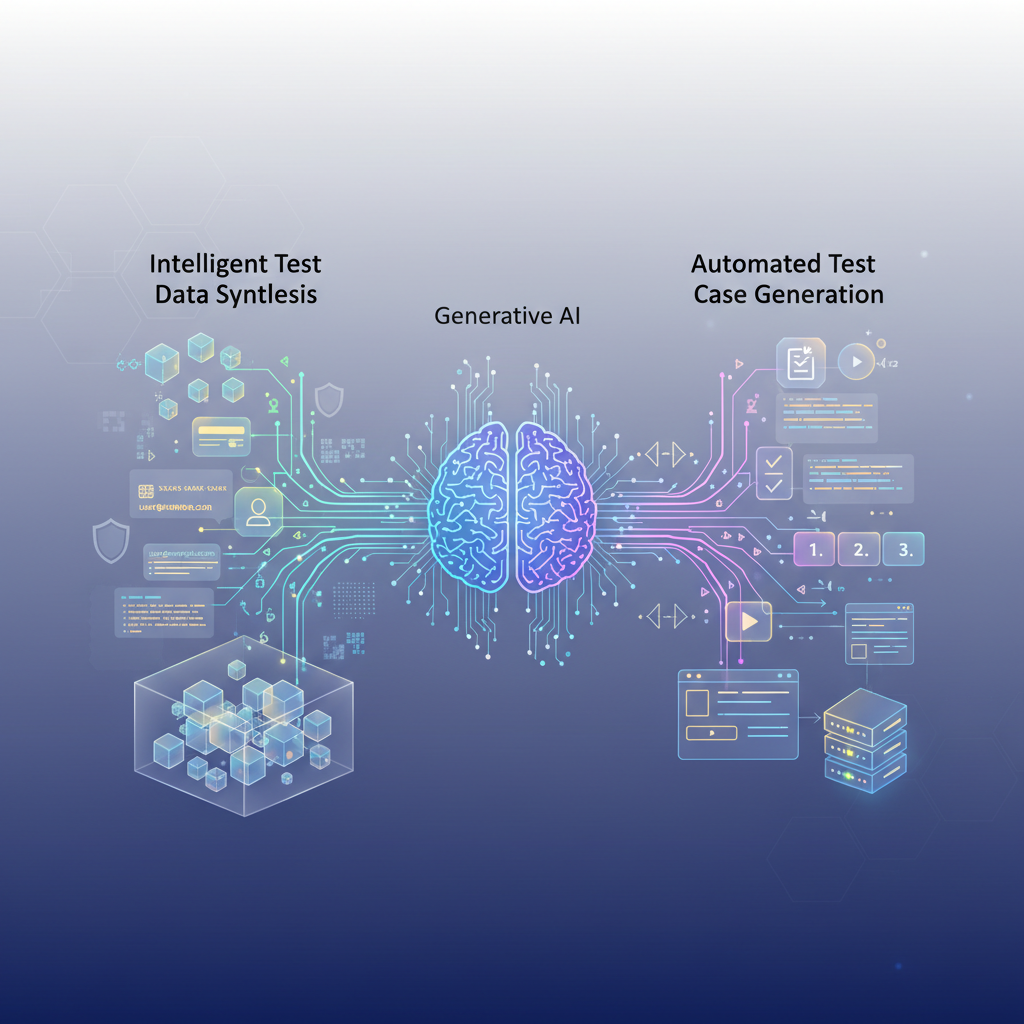
Generative AI in QA: Intelligent Test Data Synthesis & Automated Test Case Generation
Explore how Generative AI is revolutionizing software quality assurance by enabling intelligent test data synthesis and automated test case generation, addressing challenges like data scarcity and privacy in modern systems.
The landscape of software quality assurance (QA) and quality control (QC) is undergoing a profound transformation, driven by the relentless pace of technological innovation and the escalating complexity of modern systems. While artificial intelligence has long played a pivotal role in areas like defect prediction, test optimization, and anomaly detection, the recent explosion of Generative AI has unlocked unprecedented capabilities, fundamentally reshaping how we approach testing. This post delves into one of the most exciting and impactful applications of this new paradigm: Generative AI for Intelligent Test Data Synthesis and Automated Test Case Generation.
The Imperative for AI-Driven Testing: Why Now?
The timing for this technological shift couldn't be more critical. Organizations today face a confluence of challenges that traditional QA methods struggle to address:
- Data Scarcity and Privacy: Real-world production data, while invaluable, is often sensitive, subject to stringent privacy regulations (GDPR, HIPAA), or simply insufficient to cover all testing scenarios, particularly edge cases. Accessing and utilizing such data for testing can be a legal and logistical nightmare.
- Test Case Explosion in Complex Systems: Modern architectures, characterized by microservices, distributed systems, and intricate AI models, demand an exponential growth in test cases. Manually crafting these tests is not only slow and expensive but also prone to human error and oversight, leading to critical scenarios being missed.
- Shift-Left Testing Mandate: The industry trend towards "shift-left" testing emphasizes finding and fixing defects earlier in the development lifecycle. This requires generating tests and data much sooner, ideally from requirements or design specifications, a task that manual processes often bottleneck.
- Unique Demands of AI Model Testing (MLOps): Testing AI models introduces its own set of complexities. It requires diverse, representative, and often adversarial data to ensure robustness, fairness, and generalization. Traditional data generation methods often fall short here.
- Rapid Development Cycles: Agile and DevOps methodologies demand continuous integration and continuous delivery (CI/CD), necessitating faster feedback loops. Manual test creation and data provisioning simply cannot keep pace.
- Maturity of Foundational Generative Models: The recent advancements in Large Language Models (LLMs) like GPT and diffusion models have dramatically improved the quality, versatility, and contextual understanding of generated content, making sophisticated test data and test case generation not just feasible, but highly effective.
These factors collectively highlight an urgent need for intelligent, automated solutions that can keep pace with development, ensure comprehensive coverage, and respect data privacy. Generative AI stands ready to answer this call.
Core Concepts: Intelligent Test Data Synthesis
Intelligent Test Data Synthesis is the art and science of creating synthetic data that closely mimics the statistical properties, relationships, and complexity of real-world data, without exposing sensitive information or requiring direct access to actual production data. This is not merely about random data generation; it's about creating realistic, contextually relevant, and privacy-preserving datasets.
Key Techniques Driving Data Synthesis:
-
Generative Adversarial Networks (GANs):
- How they work: GANs consist of two neural networks: a generator that creates synthetic data, and a discriminator that tries to distinguish between real and generated data. They engage in a continuous "game" where the generator learns to produce increasingly realistic data to fool the discriminator, while the discriminator improves its ability to detect fakes.
- Application: Highly effective for generating complex data types like images (e.g., synthetic medical scans for testing image recognition models), time-series data (e.g., financial transactions, sensor readings), and even structured tabular data where intricate correlations exist.
- Example: Generating synthetic customer profiles with realistic demographics, purchase histories, and browsing behaviors for e-commerce application testing, ensuring the synthetic data maintains the same statistical distributions as real customer data.
-
Variational Autoencoders (VAEs):
- How they work: VAEs learn a compressed, latent representation (a "code") of the input data. They can then decode new, similar data from this latent space. Unlike GANs, VAEs are designed to learn a smooth, continuous latent space, making it easier to interpolate and generate novel data points.
- Application: Useful for generating data where the underlying structure needs to be preserved, and for tasks like anomaly detection by identifying data points that fall outside the learned latent distribution.
- Example: Creating synthetic log entries that mimic typical system behavior, including variations in error codes, timestamps, and message formats, for testing log analysis tools.
-
Large Language Models (LLMs):
- How they work: LLMs, trained on vast amounts of text data, excel at understanding context, generating coherent text, and following instructions. Their ability to reason and generate based on patterns makes them incredibly powerful for text-based data synthesis.
- Application: Invaluable for structured and unstructured text data. This includes generating realistic customer reviews (positive, negative, neutral, with specific keywords), user inputs (diverse queries, commands), code snippets, log files, and even full documents. They can introduce variations, grammatical errors, or specific emotional tones as required.
- Example: For a customer support chatbot, an LLM can generate thousands of unique user queries, including common questions, edge-case scenarios, misspellings, and even queries expressing frustration, to thoroughly test the chatbot's understanding and response capabilities.
-
Diffusion Models:
- How they work: Diffusion models generate data by iteratively denoising a random signal. They learn to reverse a diffusion process that gradually adds noise to data, effectively learning to generate data from pure noise.
- Application: Gaining traction for generating highly realistic and diverse complex data types, including images, audio, and increasingly, structured tabular data. They often produce higher quality and diversity than GANs in certain domains.
- Example: Generating synthetic medical images (e.g., X-rays, MRIs) with various pathological conditions for training and testing diagnostic AI models, ensuring patient privacy.
-
Rule-Based/Constraint-Based Generation (Augmented by AI):
- How they work: Traditional methods rely on predefined rules and constraints to generate data. AI, particularly LLMs, can now enhance these by inferring rules from existing data, identifying complex patterns, and generating data that adheres to intricate business logic or data schemas more intelligently and dynamically.
- Application: Useful for generating data for systems with strict validation rules, such as financial transactions, legal documents, or data conforming to specific industry standards.
- Example: Generating synthetic financial transactions that comply with complex regulatory rules (e.g., KYC, AML), including various transaction types, amounts, and participant details, for testing compliance systems.
Key Capabilities of Intelligent Test Data Synthesis:
- Privacy Preservation: Generate data with similar statistical characteristics to real data but without any real identifiers, protecting sensitive information.
- Edge Case Generation: Intelligently create data that represents rare, extreme, or adversarial scenarios often overlooked by manual efforts, leading to more robust systems.
- Data Augmentation: Expand existing datasets, especially small ones, to improve model training, increase test coverage, or simulate larger user bases.
- Data Anonymization/Pseudonymization: Transform real data into synthetic versions while retaining its utility for testing, a crucial step for using production data in non-production environments.
- Data for AI Model Testing: Generate diverse and challenging inputs to test the robustness, fairness, and generalization of ML models, including "out-of-distribution" data.
Core Concepts: Automated Test Case Generation
Automated Test Case Generation aims to automatically create executable test cases (including steps, expected results, and potentially code) from various inputs such as requirements, design documents, user stories, API specifications, or even existing code. This moves beyond simply generating data to generating the logic and actions of a test.
Game-Changing Techniques:
-
Large Language Models (LLMs): This is where LLMs truly shine, acting as a "brain" for understanding and translating requirements into executable tests.
- From Natural Language Requirements: LLMs can parse user stories, functional specifications, or even informal conversations, identifying key entities, actions, and expected outcomes. They can then propose detailed test steps, preconditions, and assertions.
- Example: Given a user story like "As a customer, I want to be able to reset my password using my registered email so that I can regain access to my account," an LLM can generate test cases covering: successful reset, invalid email, email not registered, expired reset link, etc., complete with step-by-step instructions and expected results.
- From API Specifications (OpenAPI/Swagger): LLMs can understand the structure, data types, and constraints defined in API specifications. They can then generate diverse API requests, including valid, invalid, boundary-condition payloads, and automatically suggest assertions for expected responses.
- Example: For an API endpoint
/users/{id}with aPOSTmethod requiring a JSON body withname(string, required),email(string, email format), andage(integer, optional, 18-99), an LLM can generate test cases for: valid user creation, missingname, invalidemailformat,ageout of range, extra fields, etc.
- Example: For an API endpoint
- From Code/System Logs: LLMs can analyze existing codebases or system behavior logs to infer intended functionality, identify common execution paths, and generate tests that cover observed patterns or highlight gaps in existing test suites.
- Behavioral Driven Development (BDD) / Gherkin Generation: LLMs can translate high-level business requirements into Gherkin syntax (Given-When-Then), which serves as a bridge between business stakeholders and technical teams, making tests more readable and maintainable.
- Example: From a requirement "The system should prevent users from ordering more than 10 items of a single product," an LLM can generate:
Given a user has 9 items of Product A in their cart, When they try to add 2 more items of Product A, Then the system should display an error message and keep 9 items in the cart.
- Example: From a requirement "The system should prevent users from ordering more than 10 items of a single product," an LLM can generate:
- Test Script Generation: Building on the identified test cases, LLMs can generate actual executable test code in various frameworks (e.g., Playwright, Selenium for UI; JUnit, Pytest for backend; Postman collections for API) tailored to the specific actions and assertions required.
- From Natural Language Requirements: LLMs can parse user stories, functional specifications, or even informal conversations, identifying key entities, actions, and expected outcomes. They can then propose detailed test steps, preconditions, and assertions.
-
Reinforcement Learning (RL):
- How they work: RL agents learn by interacting with an environment (the software under test). They receive rewards for exploring new paths, achieving coverage goals, or finding bugs. Over time, they learn optimal strategies to generate test sequences that maximize these rewards.
- Application: Particularly effective for exploring complex state machines, user interfaces, or code paths to uncover hidden bugs or achieve high code coverage.
- Example: An RL agent could explore a web application, clicking buttons, filling forms, and navigating pages, learning to generate sequences of actions that lead to rarely accessed parts of the application or trigger specific error conditions.
-
Model-Based Testing (MBT) with AI:
- How they work: MBT traditionally involves creating a model of the system's behavior. AI can enhance this by learning or inferring this behavioral model from existing documentation, code, or execution traces. Once a robust model is established, AI can then generate test paths that explore different states and transitions, ensuring comprehensive coverage of the system's logic.
- Application: Ideal for systems with well-defined states and transitions, such as workflow engines, embedded systems, or complex business processes.
- Example: AI can infer the state machine of a banking application (e.g., account creation -> account active -> transaction -> account suspended) and generate test sequences that cover all valid and invalid transitions between these states.
Key Capabilities of Automated Test Case Generation:
- Reduced Manual Effort: Significantly decreases the time and effort required for manual test case design and writing, freeing up human testers for more complex exploratory testing.
- Increased Coverage: AI can explore a wider range of scenarios, permutations, and edge cases than humans, leading to higher test coverage and a reduced risk of missed defects.
- Early Defect Detection: By generating tests directly from requirements or design documents, defects can be identified and addressed much earlier in the development lifecycle, reducing the cost of remediation.
- Adaptability: AI-generated tests can be more easily adapted and regenerated when requirements or code change, reducing the maintenance burden of test suites.
- Contextual Understanding: LLMs, in particular, can understand the intent and nuances behind requirements, leading to more meaningful and relevant test cases that align with business goals.
Practical Applications and Use Cases
The synergy of intelligent test data synthesis and automated test case generation opens up a vast array of practical applications across the software development lifecycle:
- API Testing: Generate diverse API requests (valid, invalid, boundary conditions) and expected responses directly from OpenAPI/Swagger specifications. Synthesize complex JSON/XML payloads that adhere to schemas but also include malformed or adversarial data for security testing.
- UI Testing: Generate comprehensive test scenarios and even executable Playwright or Selenium scripts based on user stories, wireframes, or design mockups. Synthesize realistic user input data for forms, including international characters, long strings, and special characters.
- Performance Testing: Create large volumes of realistic synthetic user data (e.g., millions of unique user profiles, transaction histories) to simulate heavy loads and stress conditions, ensuring system scalability and responsiveness.
- Security Testing: Generate adversarial inputs and payloads to proactively test for common vulnerabilities like SQL injection, Cross-Site Scripting (XSS), or authentication bypasses. Create privacy-preserving data for penetration testing environments without exposing real customer information.
- Database Testing: Synthesize large, complex datasets for database schema validation, performance testing of queries, and data integrity checks, ensuring the database behaves as expected under various data conditions.
- AI Model Testing (MLOps): Generate diverse and challenging input data to test model robustness, fairness, and generalization capabilities. This includes creating "out-of-distribution" data, adversarial examples, or data representing underrepresented groups to uncover biases.
- Legacy System Testing: For systems with poor or non-existent documentation, AI can analyze existing code, system logs, or network traffic to infer functionality and generate tests and data, breathing new life into testing efforts.
- Data Migration Testing: Create synthetic source and target datasets that mirror the complexity of real data to thoroughly validate migration scripts and processes, ensuring data integrity and consistency during transitions.
Challenges and Considerations for AI Practitioners
While the promise is immense, implementing Generative AI in QA comes with its own set of challenges that practitioners must carefully navigate:
- Fidelity and Realism: Ensuring synthetic data is truly representative and realistic enough to uncover real bugs is paramount. Poorly generated data can lead to false positives or, worse, a false sense of security. Robust metrics for data quality, utility, and statistical similarity are essential.
- Bias Propagation: Generative models learn from the data they are trained on. If this training data contains biases (e.g., gender, racial, or socio-economic biases), the generated data and test cases will likely amplify these, leading to unfair or discriminatory system behavior. Careful monitoring, bias detection, and mitigation strategies are crucial.
- Hallucination: LLMs, in particular, can "hallucinate"—generating plausible but incorrect, irrelevant, or nonsensical test cases or data points. Human oversight, validation, and iterative refinement remain critical to ensure the quality and accuracy of generated artifacts.
- Computational Resources: Training and running complex generative models (especially GANs and Diffusion Models) can be resource-intensive, requiring significant computational power (GPUs) and storage.
- Integration with Existing QA Workflows: Seamlessly integrating AI-generated tests and data into existing CI/CD pipelines, test management systems, and test frameworks requires careful planning and robust API integrations.
- Interpretability and Explainability: Understanding why a generative model produced a particular test case or data point can be challenging. For debugging and building trust, some level of interpretability or explainability is often desired.
- Maintaining Context: For complex systems, ensuring LLMs retain context across multiple interactions or when dealing with intricate, multi-faceted system requirements can be difficult. Prompt engineering becomes a critical skill.
- Cost of LLM APIs: While powerful, relying heavily on commercial LLM APIs for large-scale generation can incur significant costs, necessitating careful cost-benefit analysis and potentially exploring open-source alternatives.
Future Outlook: The Autonomous QA Landscape
The synergy between Generative AI and QA automation is still in its nascent stages, yet it holds immense promise for revolutionizing the entire testing paradigm. We can anticipate several exciting developments:
- More Sophisticated Multi-Modal Data Generation: Future models will likely be capable of generating multi-modal synthetic data, where text, images, audio, and even video are coherently generated to represent a single event or scenario, enabling richer testing environments.
- Self-Healing Tests: Beyond generating tests, AI will evolve to automatically adapt and "heal" tests when the underlying UI or API changes, significantly reducing test maintenance overhead.
- Autonomous Testing Agents: The ultimate vision involves Generative AI combined with Reinforcement Learning to create truly autonomous testing agents. These agents could explore an application, identify critical paths, generate tests on the fly, execute them, and report defects with minimal human intervention, effectively becoming an AI-driven QA team member.
- AI-Powered Test Oracles: Defining expected outcomes for complex scenarios, especially in non-deterministic systems or AI models, is notoriously difficult for humans. Generative models could assist in creating "test oracles," predicting or defining expected behaviors based on system specifications and observed patterns.
Conclusion
Generative AI for Intelligent Test Data Synthesis and Automated Test Case Generation is not merely a theoretical concept; it's rapidly becoming a practical necessity for organizations striving for higher quality, faster release cycles, and more efficient testing in the face of increasing system complexity. By addressing critical challenges like data scarcity, test case explosion, and the demands of AI model testing, Generative AI empowers QA teams to move beyond traditional limitations. For AI practitioners, this area offers fertile ground for research, development, and immediate impactful applications that will define the future of software quality. Embracing these technologies is no longer an option but a strategic imperative for staying competitive in the rapidly evolving digital landscape.