Generative AI in QA: Revolutionizing Test Data & Test Case Generation
Explore how Generative AI is transforming Quality Assurance by tackling the critical challenges of test data synthesis and test case generation. Discover its practical applications and immense potential in modern software development.
The landscape of Quality Assurance (QA) and Quality Control (QC) is undergoing a profound transformation, driven by the relentless pace of technological innovation, particularly in Artificial Intelligence. Among the myriad advancements, one area stands out for its immediate impact and immense potential: Generative AI for Test Data Synthesis and Test Case Generation. This isn't just a futuristic concept; it's a practical, rapidly evolving solution addressing some of the most persistent and resource-intensive challenges in software development.
The Unseen Bottleneck: Test Data and Test Cases
Before diving into the AI-powered solutions, let's acknowledge the elephant in the room for many QA teams: creating sufficient, realistic, and privacy-compliant test data, and designing comprehensive, effective test cases.
Traditionally, these tasks have been manual, time-consuming, and often fraught with limitations:
- Test Data Scarcity: Real production data is often sensitive, containing Personally Identifiable Information (PII) or Protected Health Information (PHI), making direct use impossible due to regulations like GDPR, HIPAA, and CCPA. Anonymization is complex and imperfect. Manual data creation is slow, expensive, and rarely achieves the diversity needed to stress-test applications.
- Test Case Gaps: Manually writing test cases is prone to human bias, oversight, and can't keep pace with agile development cycles. Complex systems often have vast numbers of potential scenarios, making complete coverage an elusive dream.
- Shift-Left Imperative: The modern development paradigm demands testing earlier and faster. Waiting for manual test asset creation becomes a significant bottleneck, hindering rapid iteration and deployment.
These pain points collectively slow down development, increase costs, and ultimately impact software quality and time-to-market. This is precisely where Generative AI steps in, offering a paradigm shift.
What is Generative AI for Test Data and Test Case Generation?
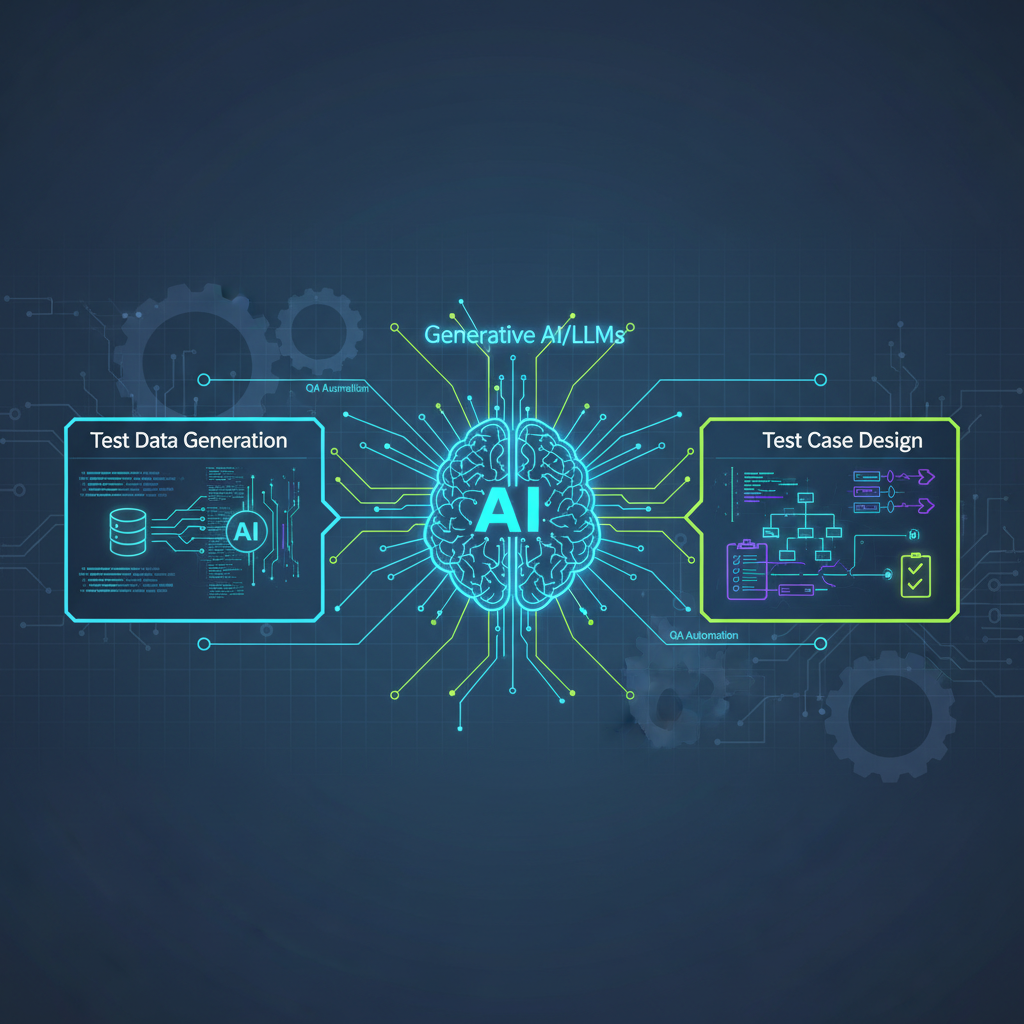
At its core, this application leverages sophisticated AI models, predominantly Large Language Models (LLMs) like GPT-3/4, Llama, and Gemini, but also other generative architectures such such as Generative Adversarial Networks (GANs) and Variational Autoencoders (VAEs). These models are tasked with two critical functions:
-
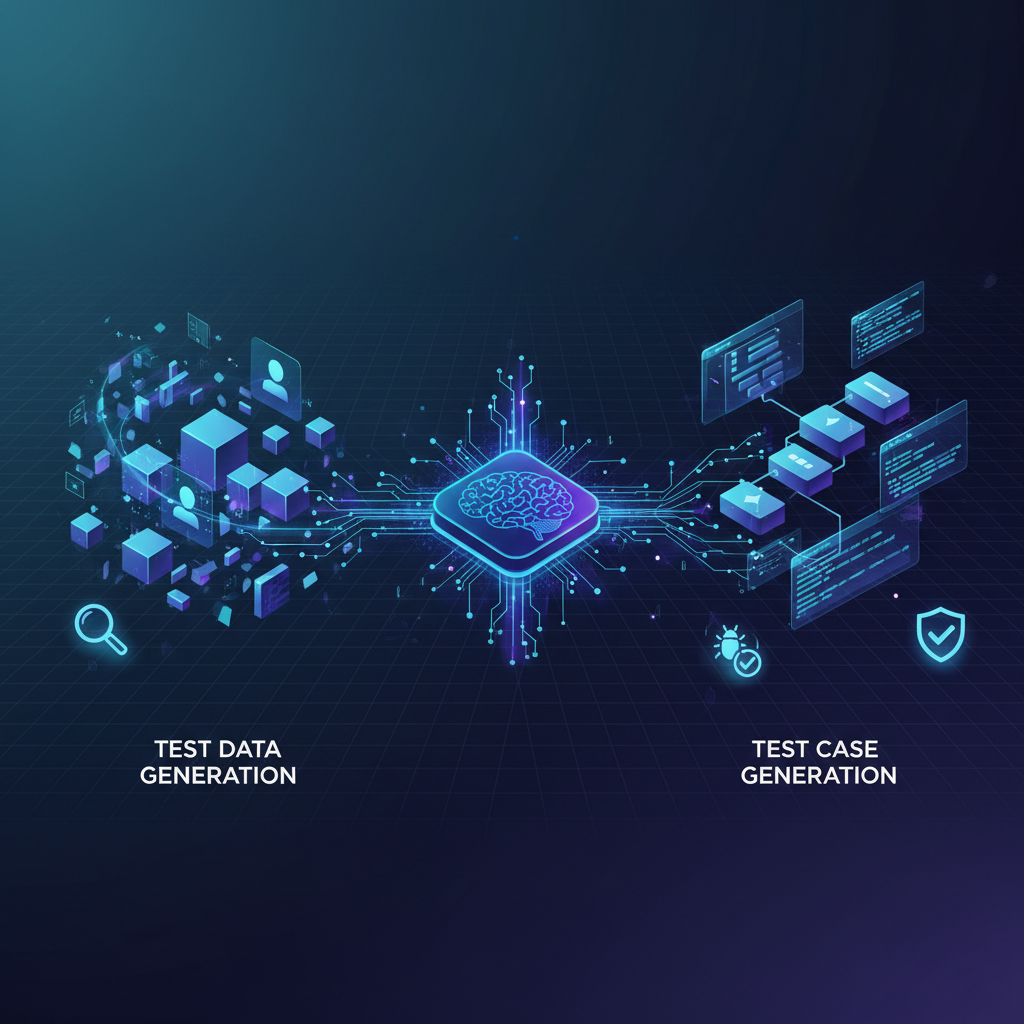
Synthesizing Realistic Test Data: This involves automatically creating diverse, high-quality, and often privacy-compliant test data. Unlike simple data masking or anonymization, generative models can mimic the statistical properties, patterns, and relationships found in real-world production data without exposing any actual sensitive information. Imagine generating a complete customer profile, including valid addresses, purchase history, and interaction logs, all statistically coherent but entirely synthetic.
-
Generating Comprehensive Test Cases: This goes beyond simple data generation to automatically design detailed test scenarios, define clear steps, predict expected outcomes, and even produce executable test scripts. The input can range from high-level requirements and user stories to detailed API specifications, code snippets, or existing documentation. The goal is to offload the cognitive burden of test design from human testers, allowing them to focus on more strategic tasks.
Why Now? The Timeliness and Impact
The explosion of interest and capability in Generative AI isn't accidental. Several converging factors make this field particularly timely and impactful:
- LLM Revolution: The unprecedented advancements and widespread accessibility of powerful generative AI models have transformed what was once theoretical into practical, sophisticated solutions. These models can understand context, generate coherent text, and even write code, making them ideal for test asset creation.
- Persistent Industry Pain Points: As discussed, the test data bottleneck and test case coverage gaps are not new problems; they are deeply entrenched challenges that have long plagued software development. Generative AI offers a viable path to overcoming them.
- Massive Efficiency Gains: Automating test data and test case creation can drastically reduce testing cycles, lower operational costs, improve test coverage, and significantly accelerate time-to-market for new features and products.
- Addressing Data Privacy: Generative AI provides an elegant solution to data privacy concerns. By creating synthetic data that statistically mirrors real data but contains no actual PII, organizations can test robustly without legal or ethical risks.
- Enabling AI-Native Applications: As more applications embed AI components, testing them becomes more complex. Generative AI can help create the diverse and often adversarial inputs needed to thoroughly test AI models themselves, ensuring their robustness and fairness.
Key Developments and Emerging Trends
The field is dynamic, with several exciting developments shaping its future:
-
Prompt Engineering for Test Cases: Testers are becoming adept at crafting sophisticated prompts for LLMs. For example, a prompt might be:
"Generate end-to-end test cases for a user login flow. Include scenarios for:
1. Valid credentials (positive test)
2. Invalid username/password combinations (negative tests)
3. Forgotten password flow (including email verification steps)
4. Multi-factor authentication (MFA) with OTP via SMS
5. Account lockout after multiple failed attempts

Refer to the attached OpenAPI specification for the authentication API endpoints and the UI wireframes for the login page."
"Generate end-to-end test cases for a user login flow. Include scenarios for: 1. Valid credentials (positive test) 2. Invalid username/password combinations (negative tests) 3. Forgotten password flow (including email verification steps) 4. Multi-factor authentication (MFA) with OTP via SMS 5. Account lockout after multiple failed attempts Refer to the attached OpenAPI specification for the authentication API endpoints and the UI wireframes for the login page."This allows for highly specific and comprehensive test generation.
-
Contextual Test Data Generation: Moving beyond simple data masking, generative models are now capable of understanding complex data relationships. They can generate a complete, consistent customer record with associated orders, payment history, and shipping addresses that are logically coherent and reflect real-world patterns.
-
Code-Aware Test Generation: LLMs are increasingly being fine-tuned on codebases to generate unit tests, integration tests, and even performance test scripts. These models can understand the underlying code logic, identify potential edge cases, and produce syntactically correct and relevant test code.
python# Example: LLM generating a Python unit test for a simple function # Original function: # def calculate_discount(price, discount_percentage): # if not (0 <= discount_percentage <= 100): # raise ValueError("Discount percentage must be between 0 and 100.") # return price * (1 - discount_percentage / 100) # Generated test case: import pytest from your_module import calculate_discount def test_calculate_discount_valid_percentage(): assert calculate_discount(100, 10) == 90.0 assert calculate_discount(50, 0) == 50.0 assert calculate_discount(200, 50) == 100.0 def test_calculate_discount_zero_price(): assert calculate_discount(0, 10) == 0.0 def test_calculate_discount_full_discount(): assert calculate_discount(150, 100) == 0.0 def test_calculate_discount_invalid_percentage_negative(): with pytest.raises(ValueError, match="Discount percentage must be between 0 and 100."): calculate_discount(100, -5) def test_calculate_discount_invalid_percentage_above_100(): with pytest.raises(ValueError, match="Discount percentage must be between 0 and 100."): calculate_discount(100, 105)# Example: LLM generating a Python unit test for a simple function # Original function: # def calculate_discount(price, discount_percentage): # if not (0 <= discount_percentage <= 100): # raise ValueError("Discount percentage must be between 0 and 100.") # return price * (1 - discount_percentage / 100) # Generated test case: import pytest from your_module import calculate_discount def test_calculate_discount_valid_percentage(): assert calculate_discount(100, 10) == 90.0 assert calculate_discount(50, 0) == 50.0 assert calculate_discount(200, 50) == 100.0 def test_calculate_discount_zero_price(): assert calculate_discount(0, 10) == 0.0 def test_calculate_discount_full_discount(): assert calculate_discount(150, 100) == 0.0 def test_calculate_discount_invalid_percentage_negative(): with pytest.raises(ValueError, match="Discount percentage must be between 0 and 100."): calculate_discount(100, -5) def test_calculate_discount_invalid_percentage_above_100(): with pytest.raises(ValueError, match="Discount percentage must be between 0 and 100."): calculate_discount(100, 105) -
Feedback Loops and Reinforcement Learning: Integrating human feedback or actual test execution results allows generative models to learn from their successes and failures. This iterative refinement helps them produce more effective and relevant test assets over time.
-
Domain-Specific Model Fine-tuning: Organizations are fine-tuning open-source LLMs or leveraging proprietary ones with their specific domain knowledge, application requirements, and existing test suites. This customization significantly improves the relevance and accuracy of generated test assets, moving beyond generic outputs.
-
Integration with Existing QA Tools: Emerging solutions are embedding generative AI capabilities directly into popular test management platforms, CI/CD pipelines, and test automation frameworks, making these powerful tools accessible within familiar workflows.
-
Synthetic Data for AI Model Training: Beyond traditional software testing, generative AI is also being used to create synthetic datasets for training other AI models, particularly in fields where real data is scarce, expensive, or highly sensitive (e.g., medical imaging, autonomous driving scenarios, financial fraud detection).
-
"Test Copilots": These intelligent assistants empower testers by suggesting test ideas, generating data snippets on demand, or even drafting entire test plans based on natural language input, significantly augmenting human capabilities.
Practical Applications and Use Cases
The theoretical promise of Generative AI translates into tangible benefits across various testing domains:
- Automated API Test Generation: Given an OpenAPI (Swagger) specification, an LLM can parse the schema and generate a comprehensive suite of positive, negative, and edge-case API requests, complete with valid and invalid payloads, and predict expected responses.
- UI Test Scenario Generation: Based on a UI design (e.g., Figma prototype, screenshot) or a user story, generative AI can outline end-to-end user journeys and even generate corresponding executable scripts for automation frameworks like Selenium or Playwright.
- Performance Test Data: Generate vast volumes of varied user profiles, transaction data, or sensor readings to simulate realistic load conditions for performance and stress testing.
- Security Testing (Fuzzing Data): Generate malformed inputs, SQL injection attempts, cross-site scripting (XSS) payloads, or other adversarial inputs to proactively uncover application vulnerabilities.
- Edge Case Discovery: Prompting an LLM to "think outside the box" can help identify unusual, overlooked, or highly specific scenarios that human testers might miss due to cognitive biases or lack of time.
- Data Migration Testing: Create synthetic datasets that accurately mimic the complexities and nuances of legacy systems, enabling thorough testing of data migration processes to new platforms.
- GDPR/HIPAA Compliance Testing: Generate synthetic PII or PHI to rigorously test data handling, anonymization, and privacy features of applications without ever touching real sensitive data.
- Regression Test Suite Augmentation: Analyze code changes and existing test suites to suggest new test cases or modify existing ones, ensuring comprehensive coverage for new functionalities or altered logic, thereby preventing regression bugs.
Challenges and Considerations
While the benefits are compelling, it's crucial to approach Generative AI with a clear understanding of its limitations and challenges:
- Hallucinations: LLMs can generate plausible but factually incorrect or irrelevant test cases/data. This necessitates human oversight and validation to ensure the generated assets are accurate and useful.
- Bias Reinforcement: If the models are trained on biased data (e.g., historical test cases that only cover certain user demographics), they can perpetuate or even amplify these biases in the generated test assets, leading to incomplete or unfair testing.
- Contextual Understanding: While improving rapidly, LLMs may still struggle with deep, nuanced understanding of highly complex business logic, specialized domain knowledge, or implicit system behaviors without proper fine-tuning or extensive, well-crafted prompts.
- Cost of Inference: Running large, sophisticated models for extensive test generation can be computationally expensive, impacting the overall cost-effectiveness, especially for smaller teams or projects.
- Integration Complexity: Seamlessly integrating these AI capabilities into existing QA workflows, CI/CD pipelines, and test management tools requires careful planning, robust APIs, and often, custom development.
- Data Quality for Fine-tuning: The effectiveness of fine-tuned models is directly proportional to the quality, relevance, and diversity of the training data used. Poor quality fine-tuning data will lead to poor quality generated assets.
- Trust and Explainability: Building trust in AI-generated test assets is paramount. Testers need mechanisms to verify the generated outputs and, ideally, understand why certain tests or data were generated, fostering confidence and enabling debugging.
Conclusion
Generative AI for test data synthesis and test case generation is not merely a theoretical concept; it is rapidly maturing into a practical, indispensable tool that promises to revolutionize how software is tested. By automating the creation of realistic data and comprehensive test scenarios, it empowers QA teams to overcome long-standing bottlenecks, accelerate development cycles, enhance test coverage, and ultimately deliver higher-quality software faster.
For AI practitioners, this field offers fertile ground for innovation in prompt engineering, model fine-tuning, integration patterns, and the development of intelligent testing agents. For QA professionals, it presents an opportunity to embrace cutting-edge technology, shifting their focus from repetitive manual tasks to strategic test design, validation, and exploration. Standing at the intersection of AI innovation and a critical industry need, Generative AI in QA is poised to unlock significant advancements in software quality and development efficiency for years to come.