Revolutionizing QA: AI-Powered Predictive Quality & Anomaly Detection in CI/CD
Discover how AI is transforming software quality assurance by enabling predictive bug detection, anticipating performance issues, and identifying security vulnerabilities before they impact users in modern CI/CD pipelines.
The relentless pace of modern software development, characterized by continuous integration and continuous deployment (CI/CD), has revolutionized how applications are built and delivered. However, this speed often comes with an inherent challenge: maintaining impeccable quality and reliability in increasingly complex systems. Traditional quality assurance (QA) and quality control (QC) methods, while essential, are often reactive, identifying issues after they've occurred. This is where the transformative power of AI steps in, ushering in an era of AI-Powered Predictive Quality and Anomaly Detection.
Imagine a world where potential bugs are flagged before they even make it into a build, where system performance degradation is anticipated hours before it impacts users, and where security vulnerabilities are identified not just by signatures but by subtle shifts in behavior. This isn't science fiction; it's the promise of AI-driven quality, and it's rapidly becoming a reality. This blog post will dive deep into this fascinating domain, exploring its core concepts, underlying AI techniques, practical applications, and the exciting future it holds for software development and operations.
The Imperative for Proactive Quality in Modern Systems
The landscape of software development has evolved dramatically. Monolithic applications have given way to distributed microservices architectures, deployed across dynamic cloud environments. CI/CD pipelines push code to production multiple times a day, and user expectations for seamless, always-on experiences are higher than ever. In this environment, the cost of a defect or an outage escalates exponentially the later it's discovered.
This critical need has given rise to a dual philosophy:
- Shift-Left: The practice of moving quality assurance activities earlier in the development lifecycle to prevent defects rather than just detect them.
- Shift-Right: The continuous monitoring and learning from production systems to understand real-world behavior, identify issues, and feed insights back into development.
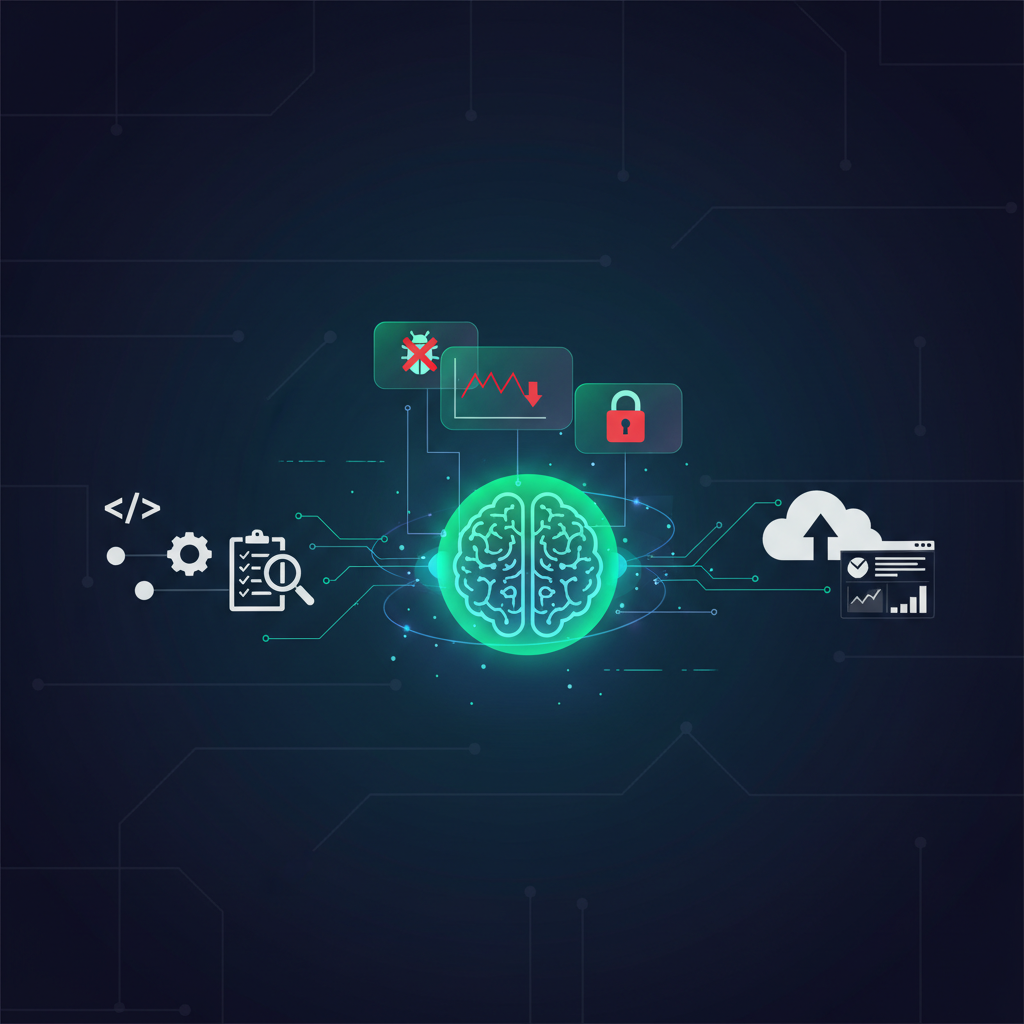
AI-powered predictive quality and anomaly detection perfectly embody both these paradigms. By analyzing the vast oceans of data generated throughout the entire software development lifecycle (SDLC) and production operations, AI can:
- Predict Future Defects: Identify code changes, development patterns, or environmental factors that are likely to introduce bugs or performance regressions.
- Proactively Detect Anomalies: Spot unusual behavior in system logs, metrics, user interactions, or sensor data that indicates an impending or ongoing quality issue – be it performance degradation, a security breach, or a functional failure.
- Optimize Testing Efforts: Guide QA teams to focus their testing resources on high-risk areas identified by AI, moving beyond rigid, predetermined test plans.
The sheer volume and velocity of data from CI/CD tools (build logs, test results, code commits), monitoring systems (metrics, traces, logs), and user feedback platforms make manual analysis impossible. AI is not just helpful here; it's essential to extract actionable insights from this data deluge.
The AI Toolkit: Techniques Powering Predictive Quality
The intelligence behind predictive quality and anomaly detection is built upon a diverse array of AI and Machine Learning (ML) techniques. Each technique brings a unique capability to the table, addressing different facets of the quality challenge.
1. Supervised Learning: Learning from Labeled Data
Supervised learning models excel when historical data is available with clear labels indicating "good" or "bad" outcomes.
- Defect Prediction: This is a prime application. Models are trained on features extracted from code (e.g., cyclomatic complexity, lines of code, number of authors, code churn), commit messages, developer activity, and test coverage. The labels indicate whether a particular code module or commit later led to a bug.
- Example: A model might learn that commits touching a high number of files with low test coverage, especially by new developers, have a higher probability of introducing defects. Algorithms like Logistic Regression, Random Forests, Gradient Boosting Machines (e.g., XGBoost, LightGBM), or even simple Neural Networks can be used.
- Practical Use: Before merging a pull request, an AI model could provide a "defect risk score," prompting additional review or testing for high-risk changes.
- Severity Prediction: Once an anomaly or potential defect is detected, supervised models can predict its likely impact or severity based on historical patterns of similar issues. This helps in prioritizing remediation efforts.
2. Unsupervised Learning: Finding the Unknown Unknowns
Unsupervised learning is crucial for anomaly detection, where it's often impossible to pre-label all possible "bad" behaviors. These models learn the "normal" patterns in data and flag anything that deviates significantly.
- Anomaly Detection:
- Techniques:
- Isolation Forests: These randomly partition data, isolating anomalies faster than normal points.
- One-Class SVMs (Support Vector Machines): Learn a boundary around the "normal" data points, classifying anything outside as an anomaly.
- Autoencoders: Neural networks trained to reconstruct their input. For normal data, reconstruction error is low; for anomalies, it's high.
- DBSCAN (Density-Based Spatial Clustering of Applications with Noise): Identifies clusters of data points and marks points that lie alone in low-density regions as outliers.
- Example: Monitoring thousands of microservice metrics (CPU, memory, latency, error rates). An Isolation Forest model could detect a sudden, uncharacteristic spike in API latency that doesn't correlate with deployment or expected load changes.
- Techniques:
- Log Pattern Recognition: Clustering algorithms can group similar log messages, even if their exact content varies slightly, to identify recurring issues or unusual event sequences.
3. Time-Series Analysis: Understanding Evolution Over Time
Most operational data – metrics, logs, traces – are time-series data. Specialized techniques are needed to understand trends, seasonality, and sudden shifts.
- Forecasting and Anomaly Detection:
- Techniques:
- ARIMA (AutoRegressive Integrated Moving Average) / SARIMA: Statistical models effective for linear time series with seasonality.
- Prophet (Facebook): Designed for business forecasting, robust to missing data and outliers, handles seasonality well.
- LSTMs (Long Short-Term Memory Networks) / Transformers: Deep learning models particularly adept at capturing complex, non-linear dependencies and long-range patterns in sequential data.
- Example: An LSTM model trained on historical CPU utilization patterns of a critical service can forecast its expected usage. A deviation of more than two standard deviations from this forecast could trigger an alert, indicating a potential resource leak or unexpected load.
- Techniques:
- Seasonal and Trend Decomposition: Separating the underlying trend, seasonal components, and residual noise from a time series helps in identifying true anomalies that aren't just part of a natural cycle.
4. Natural Language Processing (NLP): Unlocking Textual Insights
A significant portion of operational data exists in unstructured text formats, such as logs, commit messages, and issue tickets. NLP techniques are vital for extracting meaning from this data.
- Log Parsing and Analysis:
- Techniques: Regular expressions, tokenization, entity extraction, and deep learning models (e.g., BERT, GPT-like models fine-tuned for log data) can extract structured information (e.g., error codes, service names, timestamps) from raw log messages.
- Example: Automatically identifying "NullPointerException" or "Connection Timeout" patterns across millions of log lines, correlating them with specific deployments or service versions.
- Commit Message Analysis: Understanding the intent, scope, and potential impact of code changes from commit messages can feed into defect prediction models.
- Issue Ticket Analysis: Classifying, prioritizing, and linking new issue tickets to existing patterns or known root causes.
5. Graph Neural Networks (GNNs): Mapping Complex Relationships
Modern systems are highly interconnected. Microservices communicate, components depend on each other, and infrastructure forms a complex graph. GNNs are designed to operate on graph-structured data.
- Dependency Mapping: Modeling the complex relationships between microservices, modules, infrastructure components, and even development teams.
- Example: Using a GNN to understand how a change in Service A might impact Service B and Service C, which depend on it. This can help predict the "blast radius" of a potential issue.
- Root Cause Analysis: By traversing the dependency graph, GNNs can help trace anomalies back through interconnected components to pinpoint the origin of a problem.
6. Explainable AI (XAI): Building Trust and Actionability
For AI recommendations to be useful, developers and operations teams need to understand why a model made a particular prediction or detected an anomaly. XAI techniques are critical for building trust and enabling effective action.
- Techniques:
- SHAP (SHapley Additive exPlanations): Assigns an importance value to each feature for a particular prediction.
- LIME (Local Interpretable Model-agnostic Explanations): Explains individual predictions of any black-box model by approximating it locally with an interpretable model.
- Example: If an AI flags a code change as high-risk, XAI could explain that the risk is high because "function
process_orderhas high cyclomatic complexity, low test coverage, and was recently modified by a new developer." This provides concrete, actionable insights.
Practical Applications and Emerging Trends
The theoretical underpinnings translate into powerful, real-world solutions across the SDLC and production operations.
1. Intelligent Test Prioritization & Selection
In large projects, running the full test suite for every commit is time-consuming and inefficient. AI can optimize this:
- How it works: AI analyzes code changes (e.g., which files were modified, what functions were affected), historical defect data, and impact analysis (using dependency graphs). It then recommends a subset of tests that are most relevant and critical to run, maximizing coverage of high-risk areas while minimizing execution time.
- Example: A developer commits a change to the
UserAuthenticationService. The AI identifies that this service is critical, has a history of security-related bugs, and interacts with thePaymentGateway. It recommends running all unit tests forUserAuthenticationService, integration tests withPaymentGateway, and a suite of security penetration tests, while skipping unrelated UI tests.
2. Automated Root Cause Analysis (RCA)
When an incident occurs, finding the root cause quickly is paramount. AI can dramatically accelerate this process.
- How it works: AI correlates anomalies across different monitoring tools (logs, metrics, traces, events), identifying patterns and relationships that human operators might miss. Using GNNs and NLP, it can suggest potential root causes and even point to specific code changes or infrastructure components.
- Example: Users report slow login times. The AI detects anomalies in database connection pool size (metrics), increased
timeouterrors in the authentication service logs (logs), and a recent deployment of a new database driver (events). It correlates these to suggest "new database driver causing connection leaks" as a probable root cause.
3. Proactive Performance Bottleneck Identification
Performance issues often degrade gradually before becoming critical. AI can detect these subtle shifts.
- How it works: AI models learn normal performance profiles (latency, throughput, resource utilization) over various timeframes (hourly, daily, weekly). They flag deviations that indicate impending performance degradation before users are significantly impacted.
- Example: An AI model monitoring the average response time of an API notices a consistent, gradual increase of 5% over the last 24 hours, even though traffic patterns are normal. This subtle drift, which might be missed by simple threshold alerts, triggers an investigation, revealing a memory leak in a newly deployed microservice.
4. Security Anomaly Detection
Traditional security relies on known signatures. AI can detect novel threats by identifying unusual behavior.
- How it works: AI monitors access patterns, network traffic, system calls, and configuration changes. It identifies deviations from established baselines that could signal insider threats, data exfiltration attempts, zero-day exploits, or unauthorized configuration drifts.
- Example: An employee who normally accesses internal repositories during business hours suddenly attempts to download a massive amount of data from a production server at 3 AM from an unusual IP address. The AI flags this as a highly suspicious activity, triggering an immediate alert.
5. Predictive Maintenance (Beyond Software)
The principles of AI-powered anomaly detection extend far beyond software, especially in industrial IoT and hardware.
- How it works: AI analyzes sensor data (temperature, vibration, pressure, current) from machinery to predict equipment failures and schedule maintenance proactively.
- Example: In a manufacturing plant, AI monitors vibration patterns of a critical robotic arm. It detects a slight, consistent increase in a specific frequency signature, predicting a bearing failure within the next two weeks. This allows for scheduled maintenance, preventing costly unplanned downtime.
6. AI-Driven Observability Platforms
The next generation of monitoring tools are embedding AI at their core.
- How it works: These platforms go beyond collecting data; they use AI for automated anomaly detection, intelligent correlation across metrics, logs, and traces, and even suggest remediation steps or trigger self-healing mechanisms.
- Example: A platform automatically detects an increase in error rates for a specific API, correlates it with recent code changes, identifies the responsible microservice, and suggests rolling back the problematic deployment, or even initiates an automated rollback if configured.
7. Synthetic Data Generation for Edge Cases
Training robust AI models often requires vast, diverse datasets, especially for rare or complex scenarios.
- How it works: Generative AI models (like GANs or VAEs) can create realistic synthetic data that mimics real-world data distributions but includes more examples of edge cases, rare anomalies, or specific failure modes that are difficult to reproduce manually.
- Example: For testing an autonomous driving system, AI can generate thousands of simulated scenarios involving rare weather conditions, unusual pedestrian behavior, or unique road hazards that would be impractical to collect in real life.
Navigating the Challenges and Charting Future Directions
While the promise of AI-powered quality is immense, its implementation comes with a set of challenges that need careful consideration.
1. Data Quality and Quantity
AI models are only as good as the data they're trained on. Inconsistent, incomplete, or biased data will lead to flawed predictions and detections. Ensuring clean, diverse, and representative data from all stages of the SDLC and production is paramount. This often requires significant data engineering effort.
2. Concept Drift
Software systems and their operational environments are constantly evolving. Codebases change, user behavior shifts, and infrastructure is updated. This means that the "normal" patterns an AI model learned yesterday might not be valid today. AI models need continuous retraining and adaptation to remain accurate, requiring robust MLOps practices.
3. False Positives and Negatives
Balancing the sensitivity and specificity of anomaly detection models is a delicate act. Too many false positives lead to "alert fatigue," causing operators to ignore critical warnings. Too many false negatives mean missing critical issues. Tuning models and incorporating human feedback loops are essential.
4. Integration Complexity
Seamlessly integrating AI capabilities into existing CI/CD pipelines, monitoring stacks, and incident management systems is a significant undertaking. This often involves building custom connectors, APIs, and workflows to ensure data flows correctly and AI insights are actionable within existing tools.
5. Explainability and Trust
As highlighted earlier, explainability (XAI) is not a luxury but a necessity. If developers and SREs don't understand why an AI flagged something, they won't trust its recommendations, leading to adoption failure. Investing in XAI techniques and clear communication of AI insights is crucial.
6. Ethical Considerations
As AI plays a larger role in evaluating code and developer contributions, ethical considerations arise. If defect prediction models are used to assess developer performance, for instance, ensuring fairness and avoiding bias (e.g., against certain programming languages, modules, or even developer demographics) is critical.
7. Autonomous Remediation
While anomaly detection and root cause analysis are maturing, the ultimate goal of AI-driven quality is autonomous remediation – where AI not only identifies but also automatically fixes issues. This is still largely a research frontier, requiring high levels of trust, robust validation, and fail-safe mechanisms, but it represents the pinnacle of AI's potential in this domain. Imagine an AI detecting a memory leak, identifying the faulty commit, rolling back the deployment, and notifying the responsible team, all without human intervention.
Conclusion
AI-powered predictive quality and anomaly detection represents a monumental leap forward in QA and QC automation. It fundamentally shifts our approach from reactive problem-solving to proactive prevention and intelligent, continuous monitoring. By leveraging sophisticated AI and ML techniques, organizations can build more resilient, higher-quality software and systems, reduce operational costs, and significantly enhance customer satisfaction.
This interdisciplinary field, sitting at the intersection of software engineering, data science, and operational excellence, offers immense value to practitioners and enthusiasts alike. As AI capabilities continue to advance and integration challenges are overcome, we can expect to see even more sophisticated, autonomous, and intuitive AI-driven quality systems become the standard, paving the way for a future where software quality is not just assured, but intelligently predicted and maintained. The journey has just begun, and the potential for innovation is boundless.