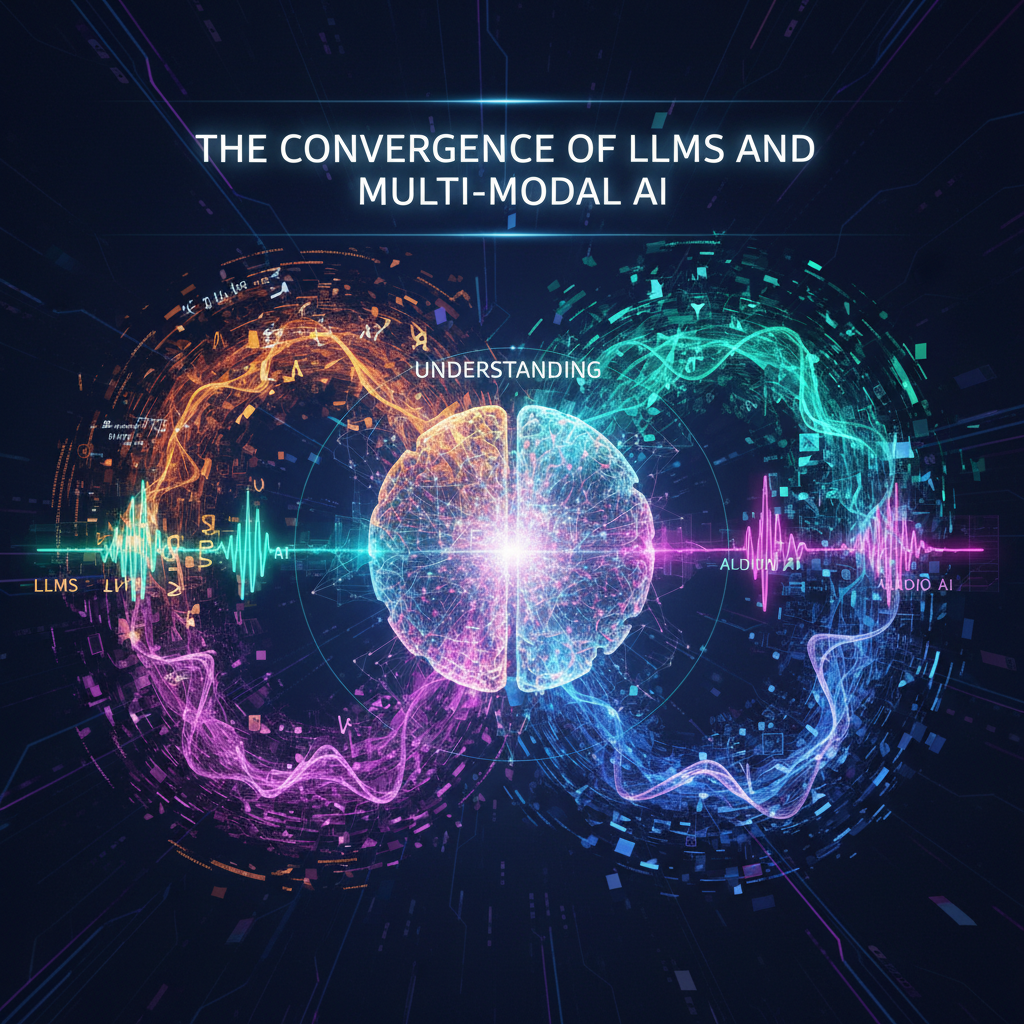
The Convergence of LLMs and Multi-Modal AI: A New Era of Understanding
Discover how Large Language Models (LLMs) are evolving beyond text to integrate with Multi-Modal AI. This paradigm shift promises AI systems that can seamlessly understand, reason, and generate across diverse data types like text, images, and audio, unlocking a more grounded and comprehensive grasp of the real world.
The world, as humans perceive it, is a symphony of senses. We don't just read words; we see images, hear sounds, feel textures, and interpret complex situations through a rich tapestry of sensory input. For decades, Artificial Intelligence has largely operated in silos, with specialized models excelling in specific modalities – text, vision, or audio. Large Language Models (LLMs) have revolutionized our interaction with text, demonstrating unprecedented capabilities in understanding, generating, and manipulating human language. Yet, their text-only nature inherently limits their grasp of the real world.
Now, a profound transformation is underway: the convergence of LLMs and Multi-Modal AI. This isn't merely about stitching together separate AI systems; it's about forging a new generation of models that can seamlessly understand, reason, and generate across diverse data types like text, images, audio, and video. This paradigm shift promises to unlock AI systems that are more grounded, context-aware, and ultimately, more human-like in their intelligence.
The Evolution: From Unimodal Specialists to Multimodal Synthesizers
To appreciate the significance of this convergence, let's first understand the journey.
The Rise of Unimodal AI
For a long time, AI development focused on mastering individual modalities:
- Natural Language Processing (NLP): From rule-based systems to statistical models, and eventually to deep learning architectures like Transformers, NLP has seen tremendous progress. LLMs like GPT-3/4, LLaMA, and PaLM represent the zenith of text-only understanding and generation, capable of complex reasoning, summarization, translation, and creative writing. Their strength lies in their ability to learn intricate patterns and relationships within vast corpora of text data.
- Computer Vision (CV): Similarly, computer vision evolved from feature engineering to convolutional neural networks (CNNs), enabling breakthroughs in image classification, object detection, and segmentation. Models like ResNet, YOLO, and Vision Transformers (ViT) have pushed the boundaries of visual perception.
- Speech Recognition and Synthesis: Deep learning has also transformed audio processing, leading to highly accurate automatic speech recognition (ASR) systems and natural-sounding text-to-speech (TTS) engines.
While powerful in their respective domains, these unimodal systems often operate in isolation. An LLM might generate a brilliant description of a scene, but it has no inherent understanding of what that scene looks like. A computer vision model might identify objects in an image, but it struggles to answer nuanced questions about the context or implications of those objects without additional text-based reasoning.
The Dawn of Multimodal AI
Multi-modal AI aims to bridge these gaps by enabling AI systems to process and integrate information from multiple modalities. Early approaches often involved:
- Feature Concatenation: Extracting features from different modalities (e.g., text embeddings and image embeddings) and simply concatenating them before feeding them into a downstream classifier or predictor. This method is straightforward but might struggle to capture complex cross-modal interactions.
- Joint Embeddings: Learning a shared, modality-agnostic embedding space where representations of related concepts across different modalities are brought closer together. Contrastive learning techniques, like those used in CLIP (Contrastive Language-Image Pre-training), are excellent examples of this, allowing for zero-shot image classification or text-to-image retrieval.
However, these earlier multimodal systems often treated modalities somewhat independently, relying on a "fusion" step rather than deep, integrated reasoning. The current convergence takes this a step further, leveraging the reasoning capabilities of LLMs as a central orchestrator.
The Core of Convergence: LLMs as Multimodal Orchestrators
The latest wave of multi-modal AI leverages the architectural strengths and pre-trained knowledge of LLMs. Instead of merely concatenating features, the LLM often acts as the central processing unit, capable of understanding prompts, generating responses, and orchestrating interactions across different sensory inputs.
How it Works: Architectural Approaches
Several architectural paradigms are emerging:
-
Encoder-Decoder Architectures with Modality-Specific Encoders:
- Concept: This approach uses separate encoders for each modality (e.g., a Vision Transformer for images, an audio encoder for sound) to extract rich features. These features are then projected into a space compatible with the LLM's input format (often as "pseudo-tokens" or "visual tokens"). The LLM's decoder then processes these combined tokens along with text prompts to generate a coherent text response.
- Example: Models like LLaVA (Large Language and Vision Assistant) exemplify this. LLaVA connects a pre-trained vision encoder (e.g., CLIP's ViT) to a pre-trained LLM (e.g., LLaMA) via a simple projection layer. The visual features are transformed into a sequence of tokens that the LLM can interpret alongside text instructions. This allows the LLM to "see" and reason about images.
python# Conceptual Pythonic representation of LLaVA's input processing from transformers import AutoProcessor, AutoModelForCausalLM from PIL import Image # Load a pre-trained LLaVA model and processor processor = AutoProcessor.from_pretrained("llava-hf/llava-1.5-7b-hf") model = AutoModelForCausalLM.from_pretrained("llava-hf/llava-1.5-7b-hf") # Example: Process an image and a text prompt image = Image.open("path/to/your/image.jpg") prompt = "USER: What is in this image? ASSISTANT:" # Prepare inputs (image features are converted to tokens internally) inputs = processor(text=prompt, images=image, return_tensors="pt") # Generate response outputs = model.generate(**inputs, max_new_tokens=200) print(processor.decode(outputs[0], skip_special_tokens=True))# Conceptual Pythonic representation of LLaVA's input processing from transformers import AutoProcessor, AutoModelForCausalLM from PIL import Image # Load a pre-trained LLaVA model and processor processor = AutoProcessor.from_pretrained("llava-hf/llava-1.5-7b-hf") model = AutoModelForCausalLM.from_pretrained("llava-hf/llava-1.5-7b-hf") # Example: Process an image and a text prompt image = Image.open("path/to/your/image.jpg") prompt = "USER: What is in this image? ASSISTANT:" # Prepare inputs (image features are converted to tokens internally) inputs = processor(text=prompt, images=image, return_tensors="pt") # Generate response outputs = model.generate(**inputs, max_new_tokens=200) print(processor.decode(outputs[0], skip_special_tokens=True))- Technical Detail: The key here is the alignment of the visual features with the LLM's token space. This is often achieved through a small, trainable projection layer (e.g., a multi-layer perceptron) that maps the high-dimensional visual features into the LLM's embedding space. The model is then fine-tuned on multimodal instruction-following datasets.
-
Unified Transformer Architectures:
- Concept: Instead of separate encoders, some models aim for a truly unified architecture where different modalities are tokenized and fed into a single, large Transformer model. The model learns to process and relate these diverse tokens directly within its attention mechanisms.
- Example: Google's Gemini is designed with this philosophy. It's inherently multimodal, capable of ingesting and processing text, images, audio, and video from the ground up within its core architecture. This allows for deeper, more integrated reasoning across modalities, as the same attention mechanisms that process text can also attend to visual or audio tokens.
- Technical Detail: This approach often involves developing specialized tokenization strategies for non-textual modalities (e.g., converting image patches into visual tokens, or audio spectrograms into audio tokens) and ensuring that the model's attention mechanisms can effectively handle the varying characteristics and scales of these tokens. The training data must be carefully curated to provide rich cross-modal relationships.
-
Cross-Modal Alignment with Shared Embeddings:
- Concept: While not strictly an LLM-centric architecture, models like Meta's ImageBind demonstrate how to learn a joint embedding space for a multitude of modalities (image, text, audio, depth, thermal, IMU data). This allows for "emergent" alignment, where a model trained on image-text pairs can then understand audio-image relationships without explicit audio-image training, simply because both are aligned with images.
- Technical Detail: ImageBind uses a simple architecture where each modality has its own encoder, and a contrastive learning objective is used to align the embeddings of related samples across different modalities. The power comes from the ability to infer relationships between modalities that were never explicitly paired during training, by leveraging common "anchor" modalities (like images).
Key Enablers:
- Large-scale Pre-training: The success of LLMs is largely due to pre-training on colossal datasets. Multi-modal models extend this by pre-training on massive datasets containing aligned text-image pairs (e.g., LAION-5B), video-text pairs, or other multimodal combinations.
- Transformer Architecture: The self-attention mechanism of Transformers is inherently flexible, allowing it to weigh the importance of different input tokens, regardless of their origin (text, visual, audio). This makes it an ideal backbone for integrating diverse modalities.
- Instruction Tuning: Fine-tuning these models on instruction-following datasets that involve multimodal inputs and outputs is crucial for enabling them to perform specific tasks like Visual Question Answering (VQA) or image captioning.
Beyond Text-Only: Emerging Capabilities
The convergence unlocks a new spectrum of AI capabilities:
- Visual Question Answering (VQA) and Visual Grounding:
- Capability: Answering complex questions about an image, requiring both visual perception and linguistic reasoning. "What is the person in the red shirt doing?" or "Why is the car parked like that?"
- Example: Uploading a photo of a broken appliance and asking, "What's wrong with this?" The AI identifies the issue and suggests troubleshooting steps.
- Image Captioning and Generation:
- Capability: Generating detailed, contextually rich descriptions for images, or creating images from elaborate text prompts.
- Example: Providing an image of a bustling city street and getting a caption like, "A vibrant urban scene with pedestrians, cars, and tall buildings under a clear sky, capturing the dynamic energy of city life." Conversely, generating an image of "a steampunk airship flying over a futuristic Tokyo cityscape at sunset."
- Video Understanding and Summarization:
- Capability: Analyzing video content to identify events, summarize narratives, or answer questions about specific moments.
- Example: Inputting a long lecture video and asking, "What were the three main points discussed in the first 15 minutes?" or "When did the speaker mention quantum entanglement?"
- Audio-Visual Scene Understanding:
- Capability: Integrating audio cues with visual information for a more holistic understanding of an environment or event.
- Example: In an autonomous driving scenario, combining visual detection of a pedestrian with the sound of footsteps or a shouted warning to predict potential hazards more accurately.
- Cross-Modal Retrieval:
- Capability: Searching for content in one modality using a query from another.
- Example: Finding all images in a database that match a detailed text description, or locating all video clips where a specific piece of music is playing.
- Embodied AI and Robotics:
- Capability: Providing AI agents and robots with a more comprehensive understanding of their physical environment, enabling more intelligent navigation and interaction.
- Example: A robot receiving a verbal command like "Pick up the red mug on the table" can use its vision to locate the object and its language understanding to confirm the target.
Practical Applications for Practitioners and Enthusiasts
The implications of multi-modal LLMs are vast and touch almost every industry:
1. Enhanced Content Creation and Marketing
- Dynamic Ad Campaigns: Generate entire ad campaigns—from compelling text copy to corresponding visual assets—from a single high-level prompt. Imagine an AI creating a social media post for a new product, complete with engaging text, relevant hashtags, and a perfectly matched image or short video.
- E-commerce Product Descriptions: Automatically generate rich, SEO-optimized product descriptions by analyzing product images, specifications, and even customer reviews. This can highlight key features, materials, and potential use cases without manual input.
- Educational Content: Create interactive learning materials where text explanations are seamlessly integrated with diagrams, simulations, or video demonstrations, adapting to different learning styles.
2. Accessibility and Inclusivity
- Assisted Living: Develop advanced screen readers that can not only read text but also describe complex images, graphs, and video content for visually impaired users, providing a richer understanding of digital information.
- Real-time Captioning and Translation: Provide highly accurate, real-time captions for live events, video calls, or broadcasts, potentially translating them into multiple languages simultaneously, benefiting hearing-impaired individuals and fostering global communication.
3. Advanced Customer Service and Support
- Visual Troubleshooting: Customers can upload images or videos of a broken product, and the AI can diagnose the issue, provide step-by-step troubleshooting guides, or even order replacement parts, significantly reducing support call times.
- Interactive Manuals: Imagine a car manual where you can point your phone camera at an engine component, and the AI instantly provides relevant information, repair steps, or diagnostic insights.
4. Robotics and Autonomous Systems
- Human-Robot Collaboration: Robots can understand complex instructions that combine verbal commands with visual cues. For example, "Move that box [pointing at a specific box] to the shelf on the left." This leads to more intuitive and efficient human-robot interaction in manufacturing, logistics, and even domestic settings.
- Enhanced Perception for Autonomous Vehicles: Integrating visual data (cameras), radar, lidar, and audio inputs (sirens, horns) allows autonomous vehicles to build a more robust and redundant understanding of their environment, leading to safer navigation.
5. Data Analysis and Research
- Social Media Intelligence: Beyond analyzing text sentiment, multi-modal AI can analyze images and videos in social media posts to understand brand perception, identify emerging trends, or detect misinformation, providing a more comprehensive view of public opinion.
- Scientific Discovery: In fields like medicine or material science, researchers can feed multi-modal data (e.g., medical images, patient records, genomic data, scientific literature) into an AI to identify correlations, hypothesize new treatments, or accelerate drug discovery.
6. Creative Tools and Entertainment
- Game Development: Generate game assets (textures, 3D models, character concepts) from textual descriptions or sketches, accelerating the creative process.
- Personalized Storytelling: Create dynamic narratives that adapt based on user input, incorporating generated images or audio to enhance immersion.
- Art and Design: Assist artists in generating concepts, variations, or even entire pieces across different mediums, from digital paintings to musical compositions.
Open-Source Opportunities for Enthusiasts
The open-source community is a vital driver of this field. Projects like LLaVA, ImageBind, and the availability of open-source LLMs (e.g., LLaMA, Mistral) and vision models (e.g., Stable Diffusion) provide incredible opportunities for enthusiasts to:
- Experiment and Fine-tune: Take existing models and fine-tune them on custom datasets for specific applications.
- Build Novel Applications: Combine different open-source components to create entirely new multimodal experiences.
- Contribute to Research: Participate in the development of new architectures, datasets, and evaluation metrics.
Challenges and Future Directions
Despite the exhilarating progress, the path to truly intelligent multimodal AI is not without hurdles:
- Computational Cost: Training and deploying these models are astronomically resource-intensive. The sheer volume of multimodal data and the complexity of the architectures demand vast computational power, limiting access for smaller teams and researchers.
- Data Scarcity and Alignment: While text and image data are abundant, high-quality, aligned multimodal datasets (e.g., video clips precisely annotated with detailed descriptions of events and emotions, or audio recordings perfectly synchronized with visual actions) are much harder to curate. The "alignment problem" – ensuring that the AI truly understands the relationship between modalities rather than just superficial correlations – is critical.
- Hallucination and Grounding: Multi-modal models can still "hallucinate" details in generated images or text that doesn't fully align with visual input. Ensuring that AI outputs are factually accurate and grounded in the provided multimodal context remains a significant challenge.
- Ethical Concerns and Bias: Biases present in unimodal datasets are exacerbated when combined. If training data over-represents certain demographics or stereotypes across modalities, the multimodal AI can perpetuate and even amplify these biases, leading to unfair or harmful outputs (e.g., generating stereotypical images from certain text prompts).
- Robust Evaluation: Developing comprehensive and robust evaluation metrics for multimodal models is complex. How do we quantify "understanding" or "reasoning" when inputs and outputs span different modalities? Traditional metrics often fall short.
- Architectural Innovation: While Transformers are powerful, researchers are actively exploring new architectures that can more intrinsically integrate and reason across modalities, moving beyond simple concatenation or attention mechanisms. This includes exploring novel ways to represent and fuse information from different sensory streams.
- Real-time Processing and Efficiency: For applications like autonomous driving, live video analysis, or real-time human-robot interaction, these complex models need to operate with extremely low latency. Optimizing these models for real-time performance on edge devices is a crucial area of research.
- Causal Understanding: Current models are excellent at identifying correlations. The next frontier is to imbue them with a deeper causal understanding of how different modalities interact and influence each other, moving closer to human-level intelligence.
Conclusion: A New Era of AI Intelligence
The convergence of Large Language Models and Multi-Modal AI marks a pivotal moment in the history of artificial intelligence. By allowing AI systems to perceive and reason across text, images, audio, and video, we are moving beyond the limitations of unimodal understanding towards a more holistic, grounded, and human-like intelligence.
This isn't just a technical advancement; it's a fundamental shift in how AI interacts with and comprehends our world. From revolutionizing content creation and enhancing accessibility to powering more intuitive robots and accelerating scientific discovery, the practical applications are boundless. While significant challenges remain in terms of computational cost, data alignment, ethical considerations, and robust evaluation, the rapid pace of innovation suggests that these hurdles are not insurmountable.
For AI practitioners and enthusiasts, this field offers an unparalleled opportunity to contribute to the next generation of intelligent systems. The journey towards truly versatile and context-aware AI is well underway, and the multimodal LLM stands as a beacon, guiding us towards an future where AI can truly see, hear, and understand the world in all its rich complexity.